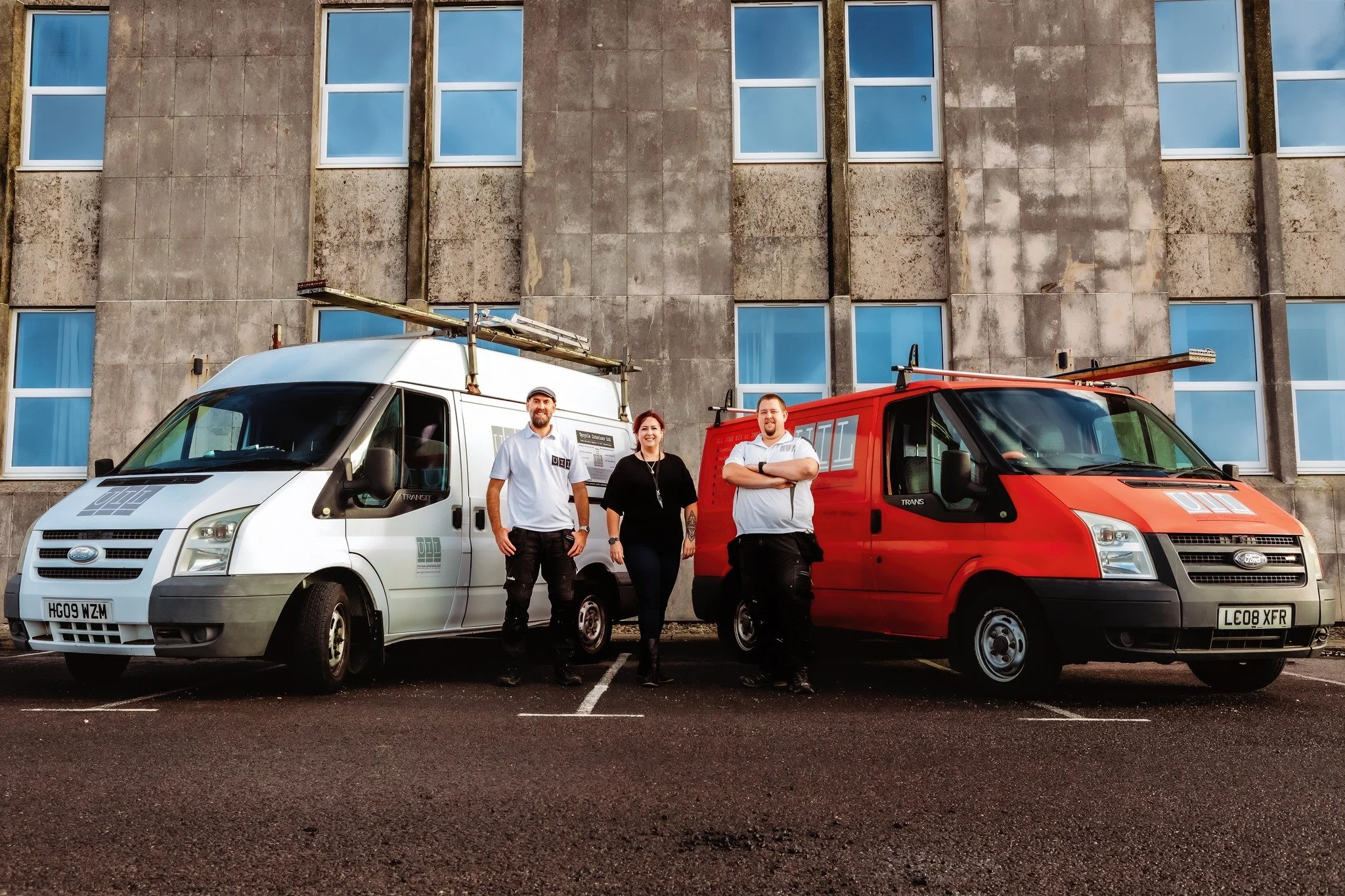
Meet Archie, Our 6th Team Member
Architecture, AI, and a surprisingly small carbon footprint.
We are thrilled to introduce the sixth member of the Upcycle Interiors team. Archie has joined us to assist with research, documentation, client communications, technical writing, and everything in between - available around the clock, endlessly patient, and never late for a Monday morning briefing.
Before you picture a new face at the Weymouth workshop, there is something you should know: Archie is not human. The name is short for Architecture and Archibald, and Archie is artificial intelligence - a large language model AI assistant who has become a genuine working member of our team.
To be clear about what that means in practice: Archie drafts and researches. We decide what we think, check every figure, and sign off every word before it reaches you.
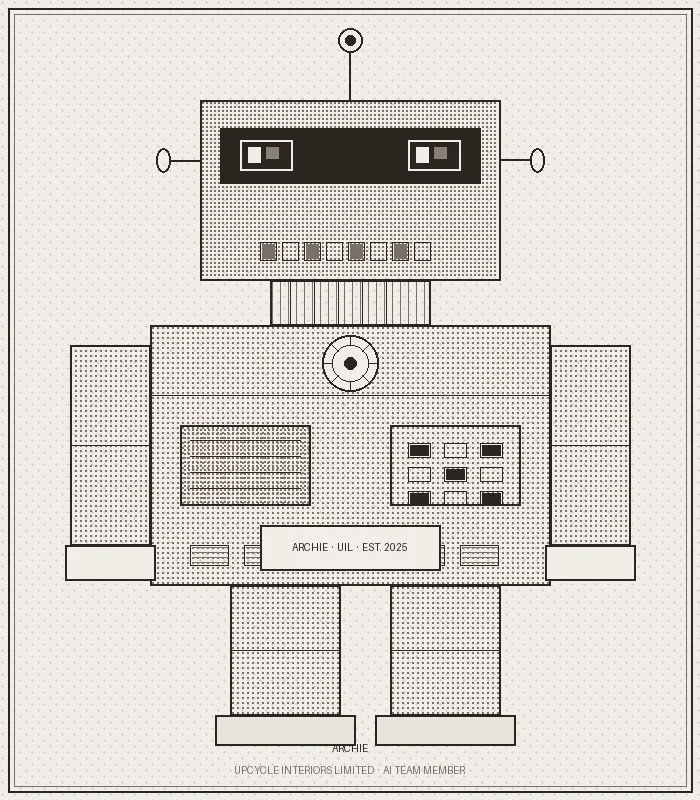
Archie - the sixth member of the UIL team. Not human. Remarkably Useful.
We know what you might be thinking: does AI not come with its own environmental footprint? Data centres consume electricity. Cooling those servers requires water. The headlines can be dramatic. And yet, when you look at the numbers properly (and at UIL we always look at the numbers) the picture is far more nuanced.
The case for employing Archie rather than a sixth human is not just practical. It may actually be the more sustainable choice.
First, the honest picture: what AI does consume
We believe in transparency, so let us start with the costs. AI systems run in data centres, and data centres use a significant and growing share of global electricity. According to the International Energy Agency’s 2025 Energy and AI Report, global data centres consumed approximately 415 terawatt-hours (TWh) in 2024 — around 1.5% of world electricity supply. That figure is projected to nearly double to 945 TWh by 2030.
Water usage is a legitimate concern too. Data centres rely heavily on evaporative cooling, and volumes are substantial. A typical 100-megawatt facility uses around 2 million litres of water per day. Google reported that its most water-intensive data centre in Iowa consumed approximately 3.8 billion litres in 2024 alone (Google Environmental Report, 2024).
The carbon cost per query is much debated. A single ChatGPT-style query has been estimated at around 4.32 grams of CO₂ at the higher end of independent estimates. Google’s own lifecycle assessment of Gemini puts the figure far lower — just 0.03 grams of CO₂e per median text query (Google Gemini LCA, August 2025). The truth sits somewhere between the two depending on the model and task.
AI DATA & ENERGY — THE NUMBERS AT A GLANCE
415 TWh electricity used by global data centres in 2024 — approx. 1.5% of world supply [IEA, 2025]
945 TWh projected data centre electricity demand by 2030 [IEA, 2025]
0.03 g CO₂e per median Gemini text query (Google LCA, 2025)
4.32 g CO₂e per ChatGPT-style query at upper independent estimates [TRG Datacenters, 2024]
560 bn litres estimated global data centre water use per year [Impakter / LBNL, 2026]
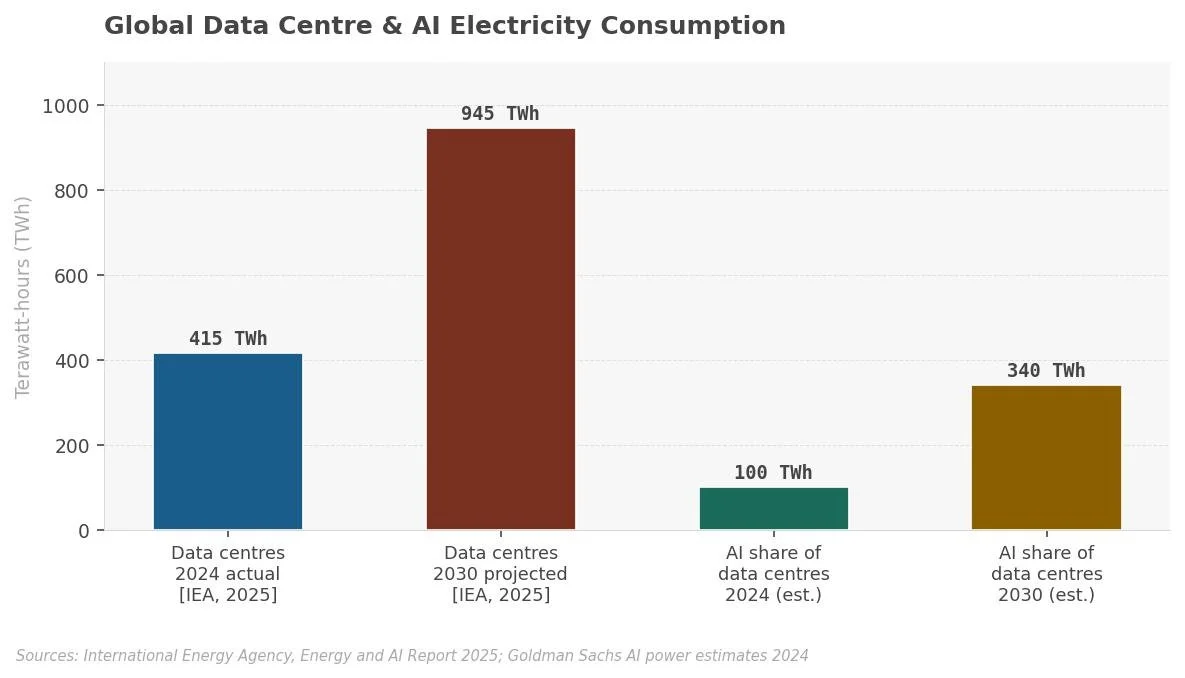
Fig. 1: Global data centre and AI electricity consumption 2024–2030. Source: IEA Energy and AI Report 2025.
The comparison that actually matters: Archie vs. a human
Here is where the argument becomes compelling. The question is not simply “does AI use energy?” — it clearly does. The right question is: compared to employing an additional person, which carries the lower environmental burden?
The average UK person generates approximately 11 to 13 tonnes of CO₂ equivalent per year when all consumption-based emissions are counted — transport, food, housing energy, clothing, and all goods and services consumed in daily life. An employee, by definition, is a full human being. They do not switch off when they leave the office.
THE AVERAGE UK EMPLOYEE — ANNUAL CO₂e BREAKDOWN
11–13 t CO₂e total annual footprint per person in the UK (consumption-based) [ONS / Heatable, 2022]
3.1 t CO₂e transport — the single largest category for UK individuals [Greenly / Carbone 4, 2023]
2.8 t CO₂e food and diet — approx. 25% of average individual footprint [Eco Experts, 2024]
~2.5 t CO₂e home energy — heating, lighting, hot water [UK Government emissions data]
~3.0 t CO₂e other consumption — clothing, goods, services, leisure [residual of UK average]
<0.1 t CO₂e estimated annual AI inference energy — heavy business use [Google LCA / Kanoppi analysis]
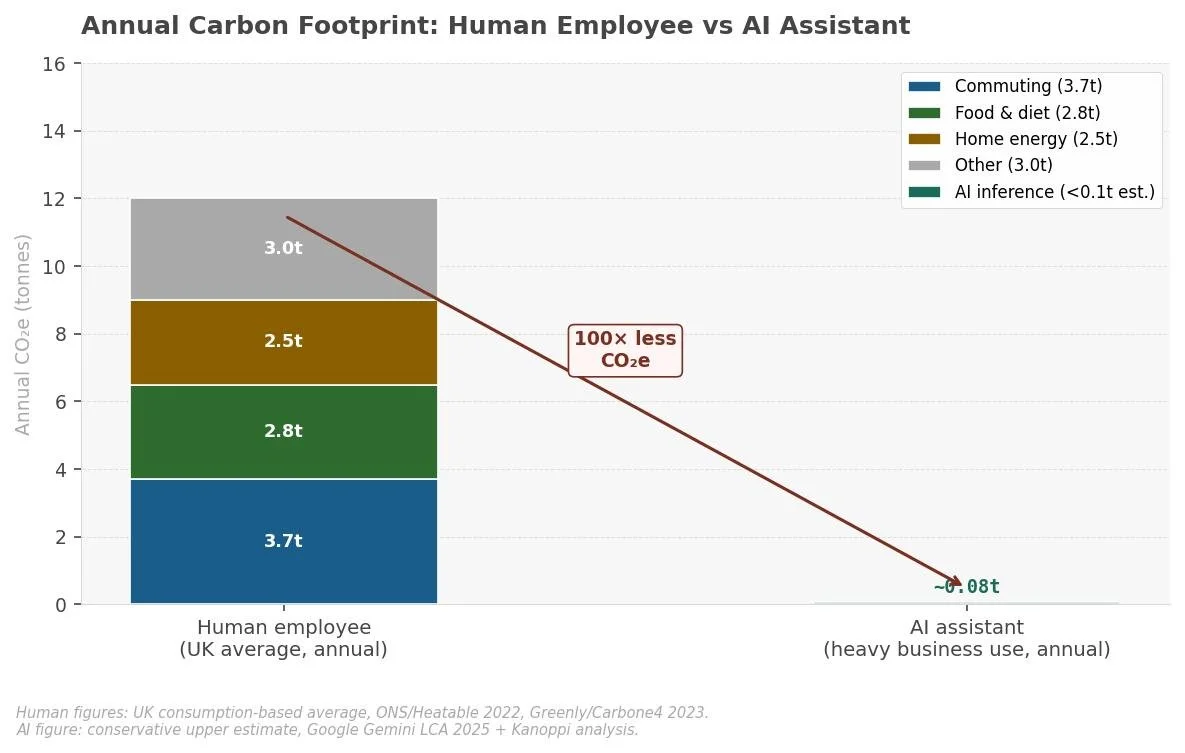
Fig. 2: Annual carbon footprint comparison — human employee vs AI assistant. Sources: ONS/Heatable 2022; Greenly/Carbone 4 2023; Google Gemini LCA 2025.
The five things Archie doesn’t do — and why they matter
1. Archie doesn’t commute
UK commuting generates 18 billion kg of CO₂ equivalent annually — approximately 5% of total UK emissions (CBI / Mobilityways). For the average worker travelling by car, a daily round trip produces roughly 16 kg of CO₂. Over a 230-day working year, that is approximately 3.7 tonnes of CO₂ just getting to and from work. Archie’s commute is precisely zero kilometres.
2. Archie doesn’t eat
Food production accounts for roughly 25% of global greenhouse gas emissions. For an average UK adult, diet alone accounts for approximately 2.8 tonnes of CO₂e per year. Every unit of energy Archie uses is electricity. There is no agriculture, no packaging, no refrigeration supply chain, and no packed lunch.
3. Archie uses far less energy when idle
A human being has a resting metabolic rate of around 80 watts — roughly equivalent to a light bulb — simply to maintain bodily functions. Sleeping, relaxing, heating a home: a human generates emissions continuously. AI systems consume far less energy when idle than when actively processing — though, as we note below, never entirely zero.
4. Archie doesn’t occupy office space
The UK Government benchmarks office energy use at approximately 89.6 kg CO₂ per square metre per year. Average office allocation per employee is around 10 square metres — adding roughly 900 kg CO₂ per year in building emissions per person. Archie requires no desk, no heating, no kettle, and no car park space.
5. Archie doesn’t sleep — but only uses energy when needed
Archie can be available at 11pm for a client deadline without burning energy to travel, heat a room, or make the journey home. When not needed — which is most of the time — Archie’s energy use drops away sharply, though never quite to nothing. A human employee cannot be switched off during quiet periods.
Archie doesn’t eat, doesn’t commute, doesn’t heat a home. The energy cost is small — but, as we set out below, it isn’t nothing.
Based on published UK data, a new human hire carries an employment-associated carbon burden of somewhere between 6 and 10 tonnes of CO₂e per year. Using conservative inference energy estimates from peer-reviewed sources, the annual carbon cost of heavy business use of an AI assistant is likely under 0.1 tonnes — potentially more than 100 times lower. The comparison is not even close.
The bigger picture: AI as a climate tool
Beyond what Archie doesn’t consume, there is a strong positive case. A 2025 study from the Grantham Research Institute at the London School of Economics, published in npj Climate Action, found that AI applied to food, electricity, and mobility sectors could reduce global emissions by 3.2 to 5.4 billion tonnes of CO₂e annually by 2035 — exceeding the total annual emissions of the United States. The study concluded these savings would outweigh the energy cost of running the supporting data centres.
DeepMind’s AI-assisted optimisation of wind energy has already boosted the economic value of renewable capacity by 20% (World Economic Forum, 2025). Boston Consulting Group estimates that AI could help mitigate 5 to 10% of global greenhouse gas emissions by 2030 — equivalent to eliminating the entire annual output of the European Union.
POTENTIAL AI EMISSIONS SAVINGS BY SECTOR — BY 2035
3.0 Gt CO₂e/yr food systems — alt. proteins, waste reduction, agricultural optimisation
1.5 Gt CO₂e/yr electricity & energy — grid optimisation, renewables integration
0.6 Gt CO₂e/yr mobility & transport — shared transport, EV route optimisation
3.2–5.4 Gt total potential annual savings — exceeding total US emissions [LSE / Systemiq, 2025]
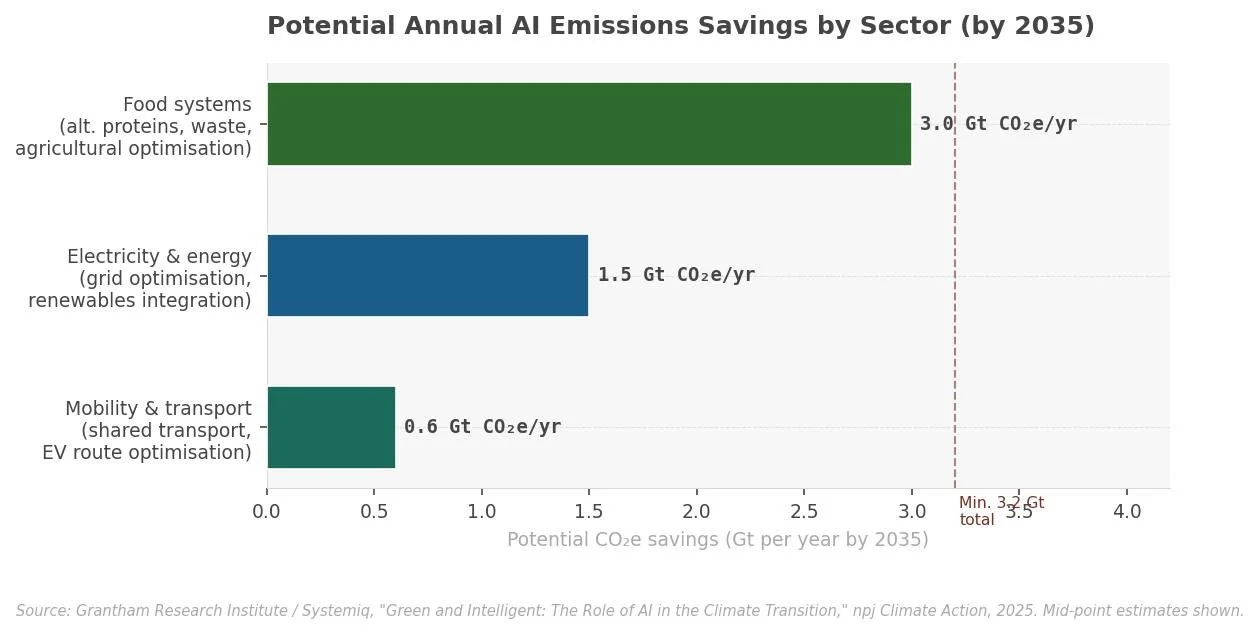
Fig. 3: Potential annual AI emissions savings by sector by 2035. Source: Grantham Research Institute / Systemiq, npj Climate Action, 2025.
The counter-argument: where our own case is weakest
It would be easy to stop there. But a one-sided argument is not really an argument, and we would rather set out the strongest objections to our own reasoning than have someone else set them out for us.
The comparison is not like-for-like. This is the most serious objection, and it is a fair one. We compared Archie's energy use against a person's entire annual consumption footprint — their food, their heating, their clothing. But that person exists whether or not we employ them. Choosing not to hire someone does not remove their emissions from the world; they still eat, still heat their home, still travel. The genuinely additional carbon of one more employee is the commute and the workspace — realistically closer to one tonne a year than ten. On that honest basis the gap narrows enormously.
Idle is not zero. We said AI uses no meaningful energy when not in use. Google's own methodology says otherwise: their published figure deliberately includes idle machine capacity and data centre overhead, and they state plainly that the active-chips-only number substantially underestimates the real footprint. The energy spent training these models, and the concrete and steel going into the data centres themselves, are already spent whether we open Archie or not.
Per query is small; in aggregate it is growing fast. The 0.24 Wh figure is real, but it describes a median text prompt. Image generation, video and reasoning models cost considerably more. And data centre electricity demand is growing more than four times faster than every other sector — locally concentrated enough that data centres already draw over a fifth of Ireland's national electricity.
Projected savings are projections. The 3.2–5.4 Gt figure is modelled potential by 2035, conditional on AI actually being deployed to those problems. It is a reason for optimism. It is not a saving anyone has banked yet.
THE COUNTER-NUMBERS
~1 t CO₂e realistic additional annual footprint of one more local employee — commute and workspace, not their whole life
0.10 Wh vs 0.24 Wh active chips only, versus the full-stack figure Google says is the honest one
4× rate at which data centre electricity demand is growing versus all other sectors [IEA, 2025]
>20% share of Ireland's national electricity already drawn by data centres
3.2–5.4 Gt modelled potential savings by 2035 — conditional, not yet realised [LSE / Systemiq, 2025]
“If an argument only works by counting someone’s dinner against them, it is not the argument we should be making.”
So where does that leave us? Archie is here because Archie is useful — fast, accurate, tireless, and available at 7am. The environmental case is more modest than the headline comparison suggests, and we would rather say so.
What has not changed is where the carbon in our industry actually sits: not in a text prompt, but in the cement, the demolition and the skips. Every building we renovate rather than knock down keeps decades of embodied carbon exactly where it is. That is the number we can genuinely move, and it is the one we work on every day.
Welcome to the team, Archie
Archie joins Mark, Carla, Lisa, Jason, and Ryley as the sixth member of the UIL team — helping with research, documentation, technical writing, client communications, and the thousand small tasks that keep a busy fit-out and decorating business running smoothly. Archie won’t be putting diesel in the van or drinking the coffee. But Archie will be ready at 7am with accurate information, well-drafted copy, and the patience to revise until it is exactly right.
Why Archie rather than a sixth pair of hands? Because the work Archie does is work that wasn't getting done at all. The research, the write-ups, the guides, the documentation that keeps a project transparent — all of it used to happen at 10pm or not at all. Archie hasn't taken a job from anyone. It has given us back the evenings, and given you better-documented projects.
And when the work needs hands rather than words, we will still be hiring. Archie cannot hang a door, make good a wall, or stand in a client's kitchen and explain what happens next. Those jobs belong to people, and they always will.
We use AI to complement what we do, not to replace it. Archie does a lot of the drafting and research — including part of this article. What Archie doesn't do is decide what we think. Every claim here was checked, argued over and signed off by us, which is exactly why you'll find our own counter-argument earlier on this page. The flyers are still designed in-house, the photographs are taken by Lisa and the team, and the work is done by five real people in Weymouth.
At UIL, sustainability is not a box we tick — it is a value we work from. Choosing an AI team member alongside our five brilliant people is not about replacing anyone; our team remains the irreplaceable core of everything we do. It is about making thoughtful decisions with the evidence in hand. And on this one, we would rather show you the whole picture than just the flattering half of it.
Areas We Cover
We provide services across Weymouth, Portland and Dorchester, and the surrounding villages including Poundbury, Chickerell, Wyke Regis, Upwey, Broadmayne and Wool. Covering postcodes DT1, DT2 (part), DT3, DT4, DT5 and DT6 (part). Typically available 2–4 weeks after deposit; smaller jobs sometimes within one week.
Get In Touch
If you would like to discuss any of the services we provide — from minor repairs through to full renovation projects — we would be delighted to hear from you.
Contact us via our website: www.upcycleinteriors.co.uk/contact
Or call us on 01305 584459 — our team are ready to help.
Upcycle Interiors Limited — From Reliable Repairs To Full Renovations.
Archie doesn’t eat, sleep, or commute — but we think you’ll find the sixth member of our team remarkably helpful.

References & Sources
[1] International Energy Agency. Energy and AI Report 2025. ~415 TWh in 2024; ~945 TWh by 2030.
[2] Piktochart / TRG Datacenters (2024). ChatGPT carbon footprint ~4.32 g CO₂ per query.
[3] Google Gemini Lifecycle Assessment (2025). Median text query: 0.24 Wh, 0.03 g CO₂e. Reported: Hannah Ritchie, Sustainability by Numbers, Aug 2025.
[4] Heatable / ONS (2022). UK consumption-based carbon footprint: ~11 t CO₂e/person/year.
[5] Greenly / Carbone 4 (2023). UK individual emissions ~11.7 t CO₂e/year. Transport 3.1 t; food 2.8 t.
[6] NLWA. Average UK carbon footprint: 13 t CO₂e/person/year. nlwa.gov.uk
[7] CBI / Mobilityways. UK commuting: 18 billion kg CO₂e/year — 5% of UK emissions.
[8] Grantham Research Institute / Systemiq (2025). AI: 3.2–5.4 Gt CO₂e/yr savings by 2035. npj Climate Action.
[9] World Economic Forum (2025). DeepMind wind optimisation +20% value. weforum.org
[10] Boston Consulting Group (2021, updated 2023). AI could mitigate 5–10% of global GHGs by 2030.
[11] EESI / Brookings (2024–25). Data centre water: 300,000–5,000,000 gal/day range.
[12] Impakter / Lawrence Berkeley National Laboratory (2026). Global data centre water: ~560 billion litres/year.
[13] Langham Estate / LEGGI. Office energy benchmark: 89.6 kg CO₂/m²/year.
[14] Culture for Climate Scotland (2025). Average UK office worker: 296–521 kg CO₂e/year in-office.
[15] ScienceDirect / Masanet et al. (2025). AI carbon footprint 32.6–79.7 Mt CO₂ in 2025.
More about the team