

Part 2 of 2: sunshine, wind and elbow grease — stored in a box for the day you need them.
It's Wednesday afternoon, day two of the power cut. The router is dead, your phone is on 12% and outside it's blowing a gale, with the odd break in the cloud. All the electricity you need is going past your window for free.
So how do you catch it?
At Upcycle Interiors Ltd (UIL), we spend our working lives making homes better to live in, and that includes keeping them liveable when the grid lets you down - the green way. In Part 1 we covered the first 72 hours and worked out a three-day power budget of about 400Wh: two phones, an LED lantern, a router for a few hours and an hour of laptop a day.
This post is about making that electricity yourself. It goes hand in hand with our Green Practices page: reduce, reuse, recycle, and be honest about what actually works.
It's a long read, so here's the map. First the three free sources: sun, wind and a hand crank, with the honest sums. Then the hub that stores it all: a portable power station. Then the kit we're buying and testing ourselves, with a table showing exactly what plugs into what.

Three Free Sources, One Golden Rule
Now for the fun part: three free, renewable sources of electricity that burn no fuel at all - the sun, the wind and you. None of them will boil a kettle. All of them will keep a phone alive, as long as you know what they can really do.
The trick with all three is the same: don't power things directly - fill a battery. Sunshine comes and goes, wind gusts and arms get tired. A power bank or portable power station smooths it all out: fill it whenever you can, and use it when you need to.
Solar: Sunshine In A Box
A solar panel turns light straight into electricity - no moving parts, no fuel, no noise. Panels are rated under "standard test conditions": 1,000 watts of sunlight per square metre falling squarely on the panel, roughly a clear summer midday. Even the best commercial silicon panels convert just under 25% of that into electricity, according to Germany's Fraunhofer Institute for Solar Energy Systems [1].
That gives you a rule of thumb to check against any listing, including the too-good-to-be-true ones: the area of the solar cells in square centimetres, divided by 50, is roughly the most watts the panel can make in full sun (assuming a good 20% efficiency).
So a panel the size of a phone - say 15cm by 7cm, around 100cm² of cells - can't make much more than 2 watts, whatever the box says. A fold-out panel that opens to four or five times that size might manage 8–10 watts in bright sun, at best.
Then the season bites. Weymouth is genuinely sunny: the Met Office's Wyke Regis station averages around 1,904 hours of sunshine a year, against a UK average of around 1,403 [2]. But December averages just 64.5 hours (about two hours a day) against nearly 235 in June [2]. And on the shortest day, the midday sun here climbs only around 16 degrees above the horizon.
In practice:
Stand it up. In winter, prop the panel almost upright, facing south, and turn it to follow the sun through the day.
Get it outside. Behind glass you'll lose a noticeable slice of the output: a sunny windowsill or a car dashboard works in a pinch, but a sheltered spot outdoors works better. Weigh the corners down - this is Dorset.
Fill a power bank, not the phone. A small panel's output rises and falls with every passing cloud, and a phone can keep stopping and restarting its charge. Let the power bank absorb the ups and downs, then charge the phone from the bank indoors.
Expect a top-up, not a miracle. A fold-out panel making, say, 5 watts for a couple of good winter hours puts about 10Wh into a power bank - once losses are taken off, roughly a third to a half of a phone charge. On a grey day, much less. That's the "partial charge, switch off, save it" approach that works in an emergency.
What about the little panel on a wind-up radio? Our director, Mark, was sceptical, and the maths is on his side. A panel of, say, 6cm by 4cm has about 24cm² of cells - half a watt at the very best, and a fraction of that on a winter afternoon. Topping up a phone from it would take days, if not weeks, in December. Think of it as a trickle that keeps the radio's own battery ticking over. For the phone, use a proper panel - or the crank.
Solar panels don't care what the box says. They care how many square centimetres of cell are facing the sun.

Wind: From Washing-Line Pole To Scaffold Pole
There's a certain poetry to it: the same westerlies that bring the storms can charge your phone. The Government Office for Science roundtable even notes that El Niño may bring a milder, windier start to winter, boosting the UK's own wind power generation [3].
Wind turbines obey one brutal law. The power in the wind rises with the cube of its speed: double the wind speed and you get eight times the power; halve it and you're left with an eighth [4]. Power also rises with the area the blades sweep, which is why size matters so much.
Here's what that means for a turbine with blades 1.35 metres across. That's the bigger of the two kits we're testing, which is rated at 300 watts in a 12 m/s (27mph) wind. Working back from that rating, roughly a fifth of the wind's power ends up as electricity (physics caps any turbine at 59%):
Light breeze (3 m/s, about 7mph): about 5 watts
Gentle breeze (5 m/s, about 11mph): about 20 watts
Fresh breeze (8 m/s, about 18mph): about 90 watts
Now the local reality check. The Met Office's long-term average wind speed for our district, South West England and South Wales, is around 10.5–11 knots in December and January (roughly 5.5 metres per second) measured 10 metres up [2]. Down among fences, houses and trees, the wind is slower and far more turbulent. The Carbon Trust found that the higher a turbine is mounted, the more power it can generate, and advises putting a turbine either well clear of obstacles - three to ten times their height away - or well above them [4].
That's why height and exposure matter as much as the turbine itself. On a five-metre scaffold pole in an exposed spot - the top of Portland, say, or the shingle at West Bexington - our rough estimate for the 1.35-metre turbine is somewhere around 200–450Wh a day once losses are taken off; in a more sheltered spot, think 60–200Wh. That's more than the 20Ah battery in our kit can hold - about 240Wh when full - so on a windy day, plug the power station into the socket panel while you're around to watch the voltmeter, and let it soak up the surplus. On a good day that covers most of our three-day budget - and unlike solar, it keeps going through the night and through the gloomy days when a panel barely wakes up.
No room for a scaffold pole? There's a smaller, cheaper option too: a little turbine with a rotor just 22.5cm across, on something like a rotary washing-line pole. Don't expect much - down at that height, among the fences, we'd estimate a few watt-hours a day, a sliver of a phone charge - but it works the same way, it's a brilliant project to build with the children, and every bit it stores is free.
The practicalities, because this is where DIY turbines go wrong:
It needs a controller and a battery. A turbine's raw output rises and falls with every gust, so it goes through a charge controller into a 12-volt battery — never straight into a phone or a power station. Wind controllers are designed to work with a battery connected — the manual for one typical controller says to wire the battery in before the turbine [5] — which is why both our kits pair a controller with their own 12-volt battery.
Here's how it all connects. The turbine's cable comes down the pole to the controller, which charges the 12-volt battery. A small socket panel wired to the battery gives you USB sockets for phones and power banks, a 12-volt "car" socket and a voltmeter. To top up the power station, run a car charging lead from that socket to the power station's DC input. The 12-volt battery stays wired in, so there's nothing to disconnect — just unplug the solar panel first, as it shares the same input. Keep an eye on the voltmeter and unplug before the 12-volt battery runs low: like any battery, it lasts longer if it isn't routinely run flat [6].
Match the battery to the controller. The controller's charging voltage has to suit the battery's chemistry. Budget wind controllers like these are typically designed for traditional lead-acid batteries — the seller of one near-identical controller says so outright [7] — so we've paired both kits with sealed lead-acid (AGM) batteries. If you'd rather use lithium (LiFePO4), check with the seller first. What about a spare car battery? It's lead-acid too, so it will work — but car batteries are built for short bursts of starting power, and NOCO warns they can't handle deep discharges without long-term damage [8]. A deep-cycle battery is the better buy — the UPLUS 20Ah in our bigger kit is sold as one.
Keep the electrics indoors. Only the turbine and its cable live outside. The controller, battery and power station belong somewhere dry and well ventilated, such as a utility room or garage [6] — or a shed, as long as it stays above freezing — with the cable brought in through a weatherproof gland. Don't be tempted to box the power station up at the foot of the pole: EcoFlow's manual says not to get it wet, not to block its cooling vents, and to store it somewhere dry and well ventilated — and it won't charge below 0°C [9].
Mount it like you mean it. A spinning rotor puts real load on a pole in a gust. A five-metre scaffold pole needs a solid base, guy wires and a way to lower it without climbing it. Keep the blades well out of reach and clear of overhead cables.
Lower it before a storm. Yes, really — just when it would produce the most. Small turbines have a maximum wind speed for a reason, and a flying blade is a far bigger problem than a flat phone. Charge everything before the gale; put the turbine back up afterwards.
Check planning first, and think of the neighbours. In England, a stand-alone garden turbine only avoids a planning application if it meets strict conditions — including certification under the Microgeneration Certification Scheme (MCS), blades at least five metres off the ground, and a minimum distance from your boundary — and those rules don't apply at all on designated land such as a National Landscape [10]. The budget kits we looked at list no MCS certification — and on a five-metre pole, the bigger turbine's lowest blade tip sits below five metres anyway — so expect to need planning permission, and talk to Dorset Council's planning team before you put one up. And some turbines hum.
Get the children involved in choosing the spot, reading the voltmeter and building a model turbine of their own (there are science kits in the kit list below). Just treat the real turbine as a tool, not a toy: putting it up, taking it down and maintaining it are jobs for the grown-ups.
Double the wind speed and you get eight times the power. Halve it and you get an eighth.

Hand Crank: Elbow Grease, Stored For Later
The oldest renewable of all. No sun, no wind, no problem - as long as you've got an arm and some patience.
How much can a person actually make? Researchers at Delft University of Technology measured sustained one-handed cranking and found an average of 54 watts (give or take 14) in a group of young men, and calculated that around 31 watts was a level 95% of that group could keep up [11]. They also noted that arm work needs adequate rest pauses [11]. Most of us aren't young men on a laboratory rig, so plan on the lower figure.
Some of that effort is then lost in the generator and in charging the battery; the Delft researchers' own example assumes 50% conversion efficiency [11]. So 30 minutes of steady cranking at 31–54 watts puts roughly 8–14Wh into a battery. That buys you:
Through USB: roughly half a phone charge.
Through a 3-pin socket: once the power station's inverter has taken its cut, about ten minutes of a 50-watt laptop.
Which is exactly how Mark pictured it when he briefed this guide. Crank for half an hour, have a rest, crank some more… and store it all in a battery with a proper UK 3-pin socket. When you've built up enough, plug the laptop in, send the emails that matter, and switch it off. You can't crank and compute at the same time, and you don't need to. And if you're quite handy, the generator could even be rigged up to a bicycle or an exercise bike - the right gearing helps too! It's worth the effort, because legs can work far harder than arms: in a University of Dundee study of 15 volunteers, peak oxygen uptake (a measure of how hard the body can work) was almost 40% lower cranking by arm than pedalling an exercise bike [12].
One buying warning: plenty of "hand crank generators" sold online are little dynamos designed to trickle-charge a phone or a torch, not to fill a power station. Our main pick has a regulator with a voltage dial, which is what lets it feed a power station. Set the dial to suit the power station's DC input - the voltage range printed beside the socket - not the 5 volts a phone needs, and do it before you plug anything in. We're also trying an entry-level crank (about £40 delivered) that fills a power bank over USB, for anyone who'd like to have a go before spending more. We'll measure both in watts as we test them.
The Hub: One Battery Box, Three Green Inputs
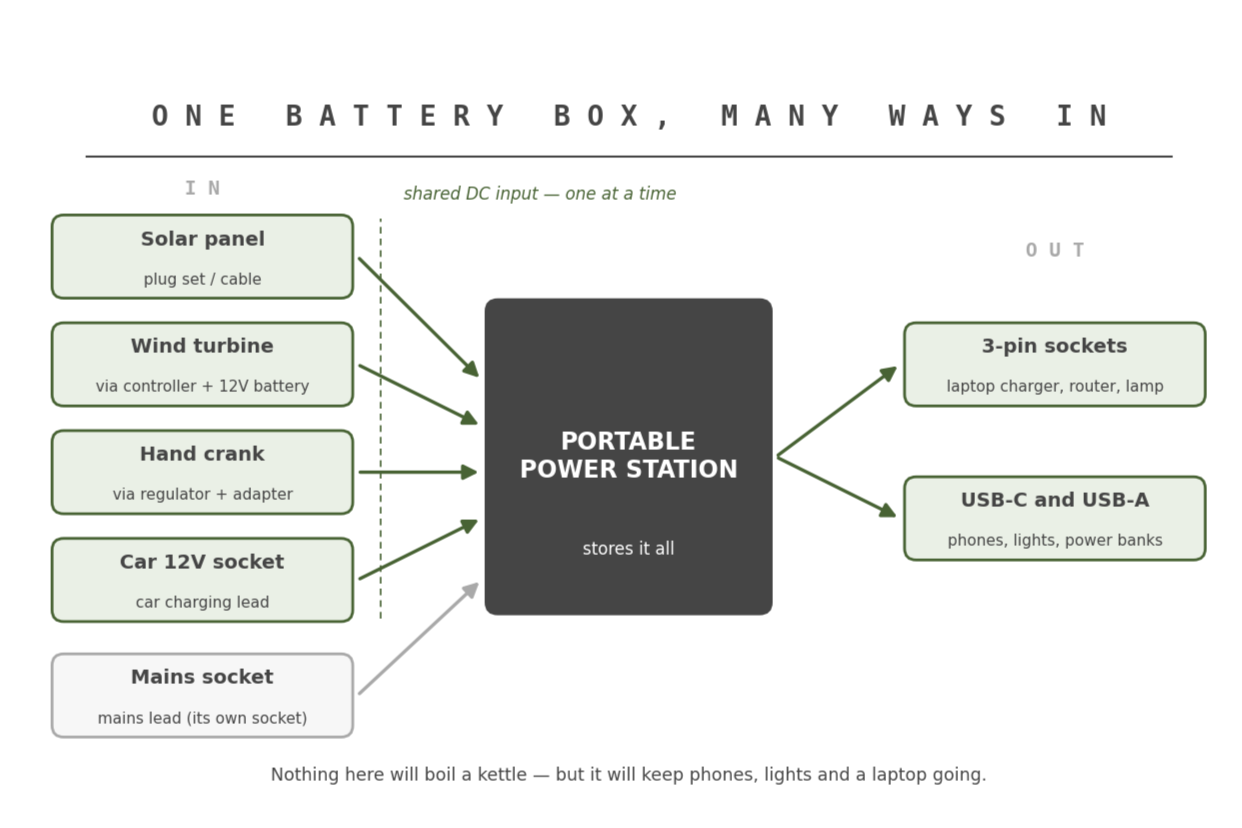
All of this comes together in one piece of kit: a portable power station. Think of it as a large rechargeable battery in a box, with UK 3-pin sockets and USB ports on the front, and several ways to fill it:
Solar — a folding panel plugged into its DC input.
Wind — a small turbine, through its charge controller and a 12-volt battery, then into the power station's DC input with a car charging lead.
Hand crank — a generator that matches its input.
Your car — from the 12-volt socket while you drive, with the same car charging lead.
The mains — whenever the power is on. Keep it topped up from the socket now: the easiest watt-hours you'll ever store are the ones you put in before the storm.
One thing to know: solar, the crank and the car charging lead all plug into the same DC input socket, so it's one at a time: the panel by day and the turbine's battery after dark, say. The mains has its own socket.
On the way out: USB for phones, lights and USB-powered gadgets; 3-pin sockets for the laptop charger, the router's own plug or a small lamp. Nothing for the kettle. If your laptop charges through USB-C, plug it into the power station's USB-C socket instead: that skips the inverter, so less of your stored energy goes to waste. And get into the habit of switching the 3-pin socket off when you're not using it - the inverter behind it uses power just by being switched on.
What we're looking for when we choose one:
Continuous watts that suit the job — enough for a laptop and router with headroom. If it can't start a kettle, that's fine.
A "pure sine wave" inverter, which is what laptop chargers and other electronics expect from a 3-pin socket.
A DC input that suits the panel and the crank — the voltage range and the plug both have to match.
LiFePO4 (lithium iron phosphate) cells, which are generally rated for thousands of charge cycles.
A dry, ventilated home. Build It magazine notes that home battery systems are typically installed in a dry, well-ventilated garage or utility room [6].
The catch is cost and weight. A power station is one of the most expensive things on this list, and the cheapest ones tend to have the smallest batteries and the fussiest inputs. Below, we compare the lowest-cost option we'd trust with a step up — disadvantages and all.
The Kit We're Buying And Testing
We don't recommend kit we wouldn't use ourselves, so we're buying these and putting them through a real Dorset winter: our own photos and results will follow. Everything here is on Amazon (affiliate links - UIL may earn a small commission at no cost to you), and prices were checked on 28 and 29 September 2026, so expect them to move. For the lithium batteries (the power station and the power bank) we've chosen listings sold by the brand's own store, because Electrical Safety First advises buying power banks and chargers from a reputable retailer rather than a third-party online seller [13]. The rest come from a mix of brand stores and smaller specialist sellers.
The Power Station: Two Options
Both are EcoFlow, so the same solar panel, crank adapter and car charging lead work with either. Both use long-life LiFePO4 cells, and EcoFlow says to charge them only between 0°C and 45°C. In the UK, neither box includes a car or solar lead: EcoFlow lists just the power station, a mains lead and the paperwork [14] [15].
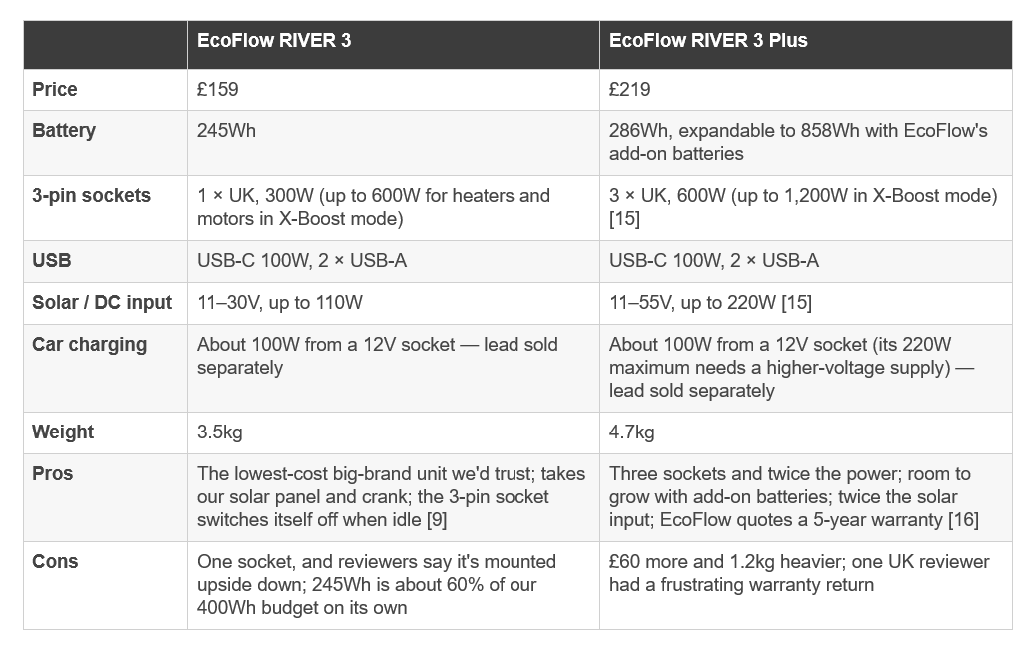
EcoFlow RIVER 3 - https://link.amazon/B0hyB3Pfm
EcoFlow RIVER 3 Plus - https://link.amazon/B08CsBbOz
For the car - and for the wind kit's socket panel - you'll need a car charging lead. We're using this KFD XT60i car charging cable, £17.99, which lists both RIVERs as compatible, is 1.5 metres long and has a 15-amp fuse. You won't need a separate solar lead with our recommended panel, though: its own plug set includes the right plug.
Solar: Three Options
Why two proper panels? The EcoFlow is the same brand as our power stations; the MHPOWOS costs less, plugs straight into either RIVER with the plugs in its box, and has USB sockets to fill a power bank or phone too. That's why it's our pick.
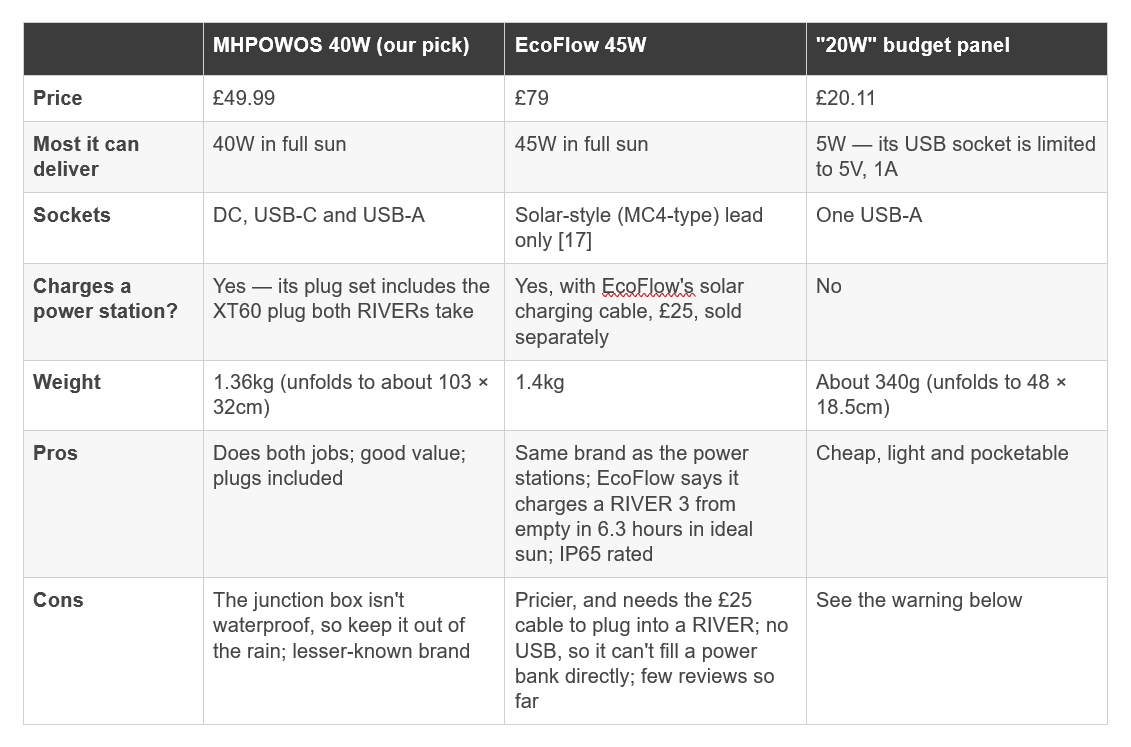
MHPOWOS 40W (our pick) - https://link.amazon/B0dLuItqp
EcoFlow 45w - https://link.amazon/B09yMvoGC
EcoFlow Solar Charging Cable - https://link.amazon/B09QneOfg
A big caveat on the "20W" panel. Despite the label, its single USB socket can only deliver 5 watts (a quarter of the headline figure) and it can't charge a power station at all. Its listing even gives a short-circuit current of 2,000 amps, which is an obvious error, so treat all its numbers with care. On a bright winter day it will give a phone or power bank a small top-up; on a grey one, next to nothing. If it's genuinely all your budget allows it's better than nothing, but a trickle of power is all you'll get.
Wind: Two Options
The bigger kit needs a scaffold pole and a windy spot; the smaller one is a family project for a washing-line pole. Both charge their own 12-volt battery through a charge controller, and both use the same socket panel, which gives you USB sockets, a 12-volt "car" socket for the power station's charging lead, and a voltmeter.
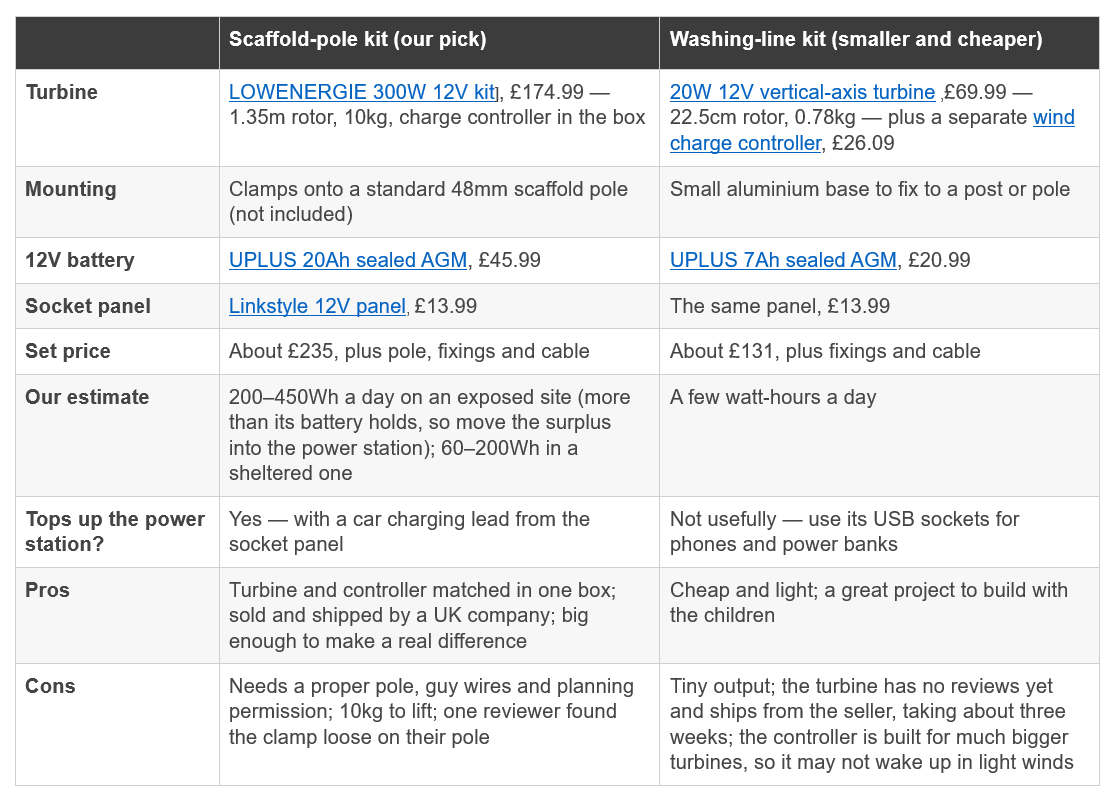
LowEnergie 300w 12v Kit - https://link.amazon/B09yMvoGC
DIY 20W 12V Vertical-axis Turbine - https://link.amazon/B0cTyx8Ra
Wind Charge Controller - https://link.amazon/B07sT97Yv
UPLUS 20Ah sealed AGM - https://link.amazon/B0b76cy3M
UPLUS 7Ah sealed AGM - https://link.amazon/B0c6TbhtB
Linkstyle 12v Panel - https://link.amazon/B0bo3sL2W
Both sets also need outdoor-grade cable, an inline fuse sized to the cable and crimp connectors to suit each terminal: ring terminals for the 20Ah battery's M5 bolts, 4.8mm spades for the 7Ah battery and 6.3mm spades for the socket panel, which comes without wires or a wiring diagram.
The Rest Of The Kit
Power bank: Anker Zolo 20,000mAh 30W, £34.99. This is the battery the solar panel fills. Once losses are taken off, it holds roughly three to four phone charges.
Already own a jump starter? Many double as a small power bank. Mark's NOCO Boost GB40 (£92.38) charges through a USB-C socket and has a USB socket for phones — if yours is an older one, check which charging socket it has. NOCO says it can be recharged from any powered USB port [18], so in principle the solar panel's USB sockets, or the crank's USB socket set to 5 volts, can top it up — we'll confirm that in testing. But it only holds 24Wh (about one modern phone charge) so it's no substitute for a proper power bank, and NOCO advises charging it between 0°C and 40°C and not charging and using it at the same time [18] [19]. It's your jump starter first, so don't run it flat if you might need the car.
Hand crank for the power station: HUABAN 30W hand crank generator with regulator, £109. It's the only one we found with a regulator able to feed a power station — set its dial to suit the power station's DC input before you plug in. Reviews are mixed (some faulty units, and it needs clamping down firmly), so we're testing ours before we recommend it. To plug it into either RIVER you'll need a small XT60 adapter [SiteStripe link: B0DGG48YTK], £8.09 for two. Its USB socket follows the dial too, so turn it back to 5 volts before plugging in a phone, power bank or jump starter.
Entry-level hand crank: want to try cranking before spending £109? This 20W hand crank generator is £20 (plus £20 delivery from its overseas seller when we checked, so about £40 in all). Its two USB sockets can fill a power bank or phone through a USB-A to USB-C cable (none in the box). With only two ratings so far it's unproven, so we're testing ours, and we'll be using it for power banks and phones only. Stick to the USB sockets: the listing says its direct-output terminals can reach about 28 volts, far more than a phone or power bank can take.
For the children: four kits to choose from, all small enough to go outside in a breeze and come back in afterwards.
Tiny: the Jadeshay mini wind turbine, £6.99 — a 9cm rotor on a little holder with a tail that turns it into the wind. It lights an LED; that's all it's for... but a good way to teach the children about renewable energy whilst setting up your own equipment.
Tabletop: the 4M Build Your Own Wind Turbine, £22.99, for ages 5+. It stands on its own base and lights an LED. UK reviewers say the blades can blow off if it's left out.
Half a metre tall: the Thames & Kosmos Wind Power V5, £41.99, for ages 8+. It has 30cm blades and lights an LED or charges a little capacitor-powered car, which is a neat way to show how the big turbine fills its battery. One reviewer found it could blow apart in a strong wind.
With a USB socket: these mini turbine kits with a USB regulator, £10.04 for two, can light a small USB LED lamp (not included). You solder them together yourselves, getting the wires the right way round: a rewarding first soldering project for an older child, with an adult alongside. They need a strong breeze or a bike ride to get going, and reviews are mixed, so we're testing ours. And the surest USB experiment of all is to plug a USB light into the big turbine's socket panel: it runs on wind you've stored.
USB cables: almost everything here connects by USB, and a thin, cheap cable can slow charging right down. For charging, what counts is the cable's power rating, not its data speed - and shorter is better, so 1 metre is plenty. We're using two sets from Anker's own store:
Anker 310 USB-A to USB-C cables, £7.49 for two 0.9m cables, rated at 3 amps and USB-IF compliant. These are the workhorses: from the solar panel's, a crank's or the socket panel's USB-A socket into the power bank or NOCO, or from any USB-A socket to a USB-C phone.
Anker 240W USB-C to USB-C cables, £8.99 for two 1m cables, for the fastest charging between two USB-C sockets - the panel's USB-C socket to the power bank, or the power station's 100W USB-C socket to a phone or USB-C laptop.
You won't need a USB-A to USB-A cable: the power bank takes its charge in through USB-C, and its USB-A socket is an output. If your phone still uses Lightning, stick with its own cable.
Radio: Esky wind-up solar radio, £25.99. AM/FM, a torch and an SOS alarm, charged by crank, solar or USB, with a small 2,000mAh battery that can give a phone a short emergency top-up.
Before You Buy: What Plugs Into What
Nothing's more frustrating than a parcel that won't connect to anything. Here's how every item on our list links up, which cable does the job, and whether it's in the box.
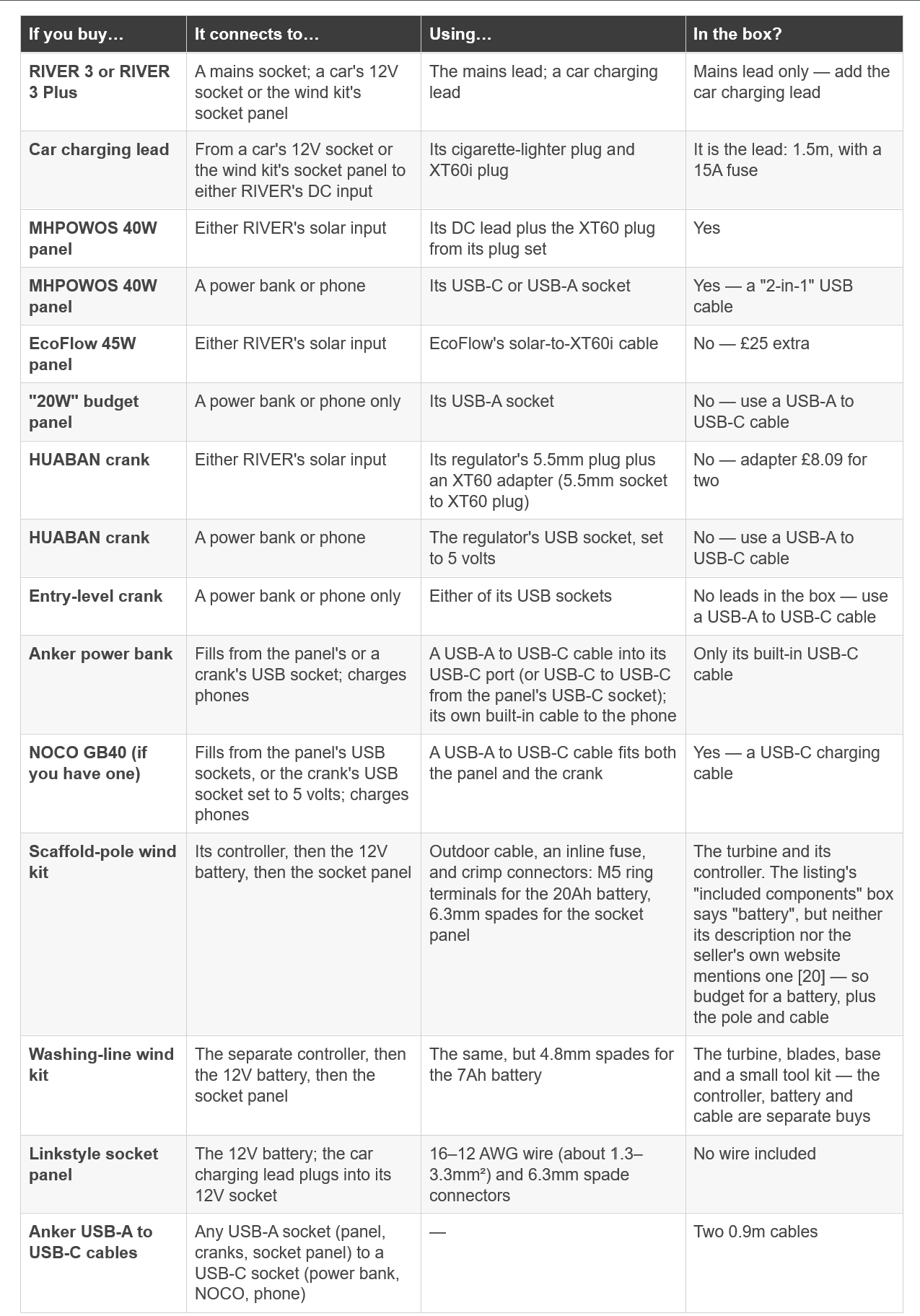
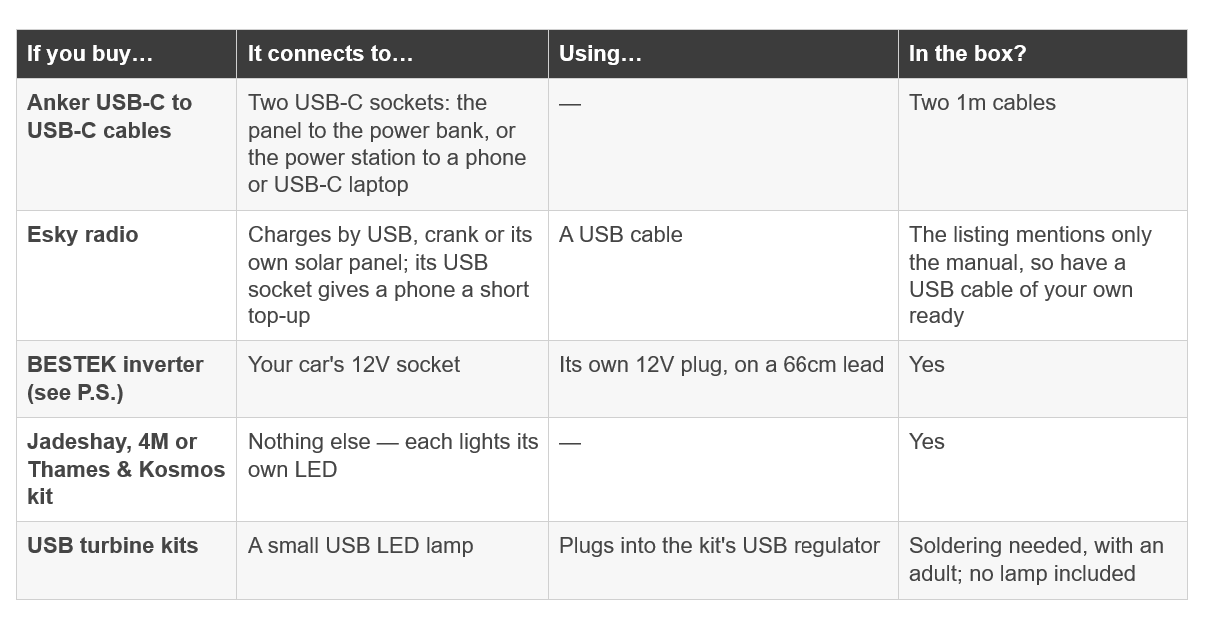
Whatever you buy, register it with the manufacturer so you hear about any safety recall, and never put lithium batteries in the bin or your normal recycling - take them to a proper recycling point [13]. Treat the lead-acid ones the same way.

Your Green Power Cheat Sheet
Now, while the sun's out
Charge the power bank and power station from the mains, and keep them topped up.
Match every cable to its socket using the table above, and test each panel, turbine and crank once before you need it.
Decide where the panel will stand and where the turbine will go, and check planning first.
Don’t forget to unplug any blackout-sensitive items such as computers or phones to protect them from power surges when the time comes.
When the lights go out
Top up the batteries whenever the sun shines, the wind blows or someone fancies a workout.
Fill the power bank first, then charge phones from it indoors.
Switch the power station's 3-pin socket off when you're not using it.
Lower the turbine before any gale.
When it's back on
Recharge everything, restock the kit, and put the turbine back up.
Start Small, Stay Green
Here's the honest bottom line. The cheapest sensible start is a good power bank and a folding panel: about £85 of kit, enough to keep a couple of phones alive. A power station adds the 3-pin socket for a laptop. The turbine is the big swing - well worth it on an exposed hill, a disappointment in a sheltered garden - and the hand crank is your elbow-grease reserve for when everything else has failed.
It's greener than it looks, too. Charge from the mains before a storm and you're storing grid power; charge from sun, wind or muscle and you're storing your own. And the best battery is one you already own: reuse before you buy, which is exactly what our Green Practices page is about.
Whether you're in Weymouth, Portland or Dorchester, or out in Burton Bradstock, Langton Herring, Owermoigne or Bincombe, a little preparation now makes for a much calmer December. And if there's anything around your home that needs doing properly — no half measures — you know where to find us.
Charge it now. Thank yourself in December.
Mark & the UIL team
P.S. Got a car or van? A small plug-in inverter in the 12-volt socket turns it into a mini generator for a laptop or phone charger. We're testing the BESTEK 300W pure sine wave inverter, £49.99, which has a UK 3-pin socket and two USB ports. Pure sine wave is what laptop chargers like.
Through the car's 12V socket, keep to 150W or less: BESTEK's own guidance is that most car sockets are rated and fused for 150W. And if you've bought either power station above, the car charging lead in our kit list lets it charge from the same 12-volt socket.
Only ever run the engine outdoors, never in a garage [21], and don't leave it idling on a public road: the Highway Code says you must not leave an engine running unnecessarily while stationary [22].

Get In Touch
✨ Ready to bring your project to life? At Upcycle Interiors, we combine professionalism, trustworthiness, and reliability to deliver results you can count on.
Whether it's a small repair or a full renovation, we'll treat your home with the care and respect it deserves.
For fuss-free fixing and finishing, contact us on:
🌐 www.upcycleinteriors.co.uk/contact
📧 sales@upcycleinteriors.co.uk
📞 01305 584459
📍 Based in Weymouth and covering all of South Dorset including DT1, DT2 (part), DT3, DT4, DT5, DT6 (part). Please do get in touch here if your area is not on the list.
Upcycle Interiors Limited — professional, trustworthy, reliable.
4.9 ★★★★★ Across 450+ Reviews Over 9 Platforms — Ranked No. 1 In The UK
Licensed Waste Disposal: Certificate reg. no. CBDU400611
Full Protection: All Quotations backed by a contract
Warranty: Work protected by 1 yr. Defect Liability Period
All staff DBS checked, certificates available upon request
All work insured (up to 4 people) Axa policy No.TP1036224
A small 10% deposit secures your project in our pipeline
VAT No. 483072978
Company No. 11641998
References
[3] https://www.gov.uk/government/publications/impacts-of-el-nino-on-the-uk/impacts-of-el-nino-on-the-uk
[6] https://www.self-build.co.uk/publication/26-8/
[8] https://no.co/support/difference-between-starter-and-deep-cycle-batteries
[11] https://www.designsociety.org/download-publication/23972/HUMAN+POWER;+COMFORTABLE+ONE-+HAND+CRANKING
[13] https://www.electricalsafetyfirst.org.uk/guidance/product-safety/power-banks/
[14] https://uk.ecoflow.com/products/river-3-portable-power-station
[15] https://uk.ecoflow.com/products/river-3-plus-portable-power-station
[16] https://www.ecoflow.com/uk/river-3-plus-portable-power-station
[17] https://us.ecoflow.com/products/45w-portable-solar-panel
[18] https://no.co/media/wysiwyg/downloads/User_Guides/Boost/GB40_User_Guide_03.07.2025A.pdf
[19] https://no.co/media/wysiwyg/downloads/brochures/Boost/GB40_Data_Sheet_12.05.2024.pdf
[20] https://lowenergysupermarket.com/product/wind-turbine-300w-12v-generator-kit/
[21] https://www.dwfire.org.uk/safety/safety-at-home/carbon-monoxide/
Disclaimer
This article is for general information only. It isn't professional electrical, gas or fire-safety advice, and every home, appliance and product is different. Always follow the manufacturer's instructions and the official guidance from the government, the Food Standards Agency and your fire and rescue service, and use a qualified professional for any installation or electrical work. Anything you do with the information or products in this article is at your own risk: to the fullest extent permitted by law, Upcycle Interiors Ltd cannot accept responsibility for anyone's safety, or for any loss, damage or injury arising from its use. In an emergency, call 999.
