

3-Day Power Cut - Are You Ready For An El Niño Winter?
Part 1 of 2: a green guide to keeping the lights on when the grid goes dark.
It's 6pm on a Tuesday in December. The lights go out, the router goes dark, your phone is on 23% and the kettle, the one thing you really want, has just become a 3,000-watt ornament.
Now imagine it stays that way until Friday.
That isn't a disaster-movie plot. After Storm Arwen in November 2021, around 40,000 customers were without power for more than three days, and nearly 4,000 for over a week [1]. This autumn, forecasters are watching the strongest El Niño ever recorded — and it has tilted the odds towards a wetter, stormier start to our winter [2] [3].
At Upcycle Interiors Ltd (UIL), we spend our working lives making homes better to live in. This post is about keeping them liveable when the grid lets you down — and doing it the green way. It goes hand in hand with our Green Practices page: reduce, reuse, recycle, and be honest about what actually works.
This is Part 1 of a two-part guide, and it's a long read, so here's the map. First come the first 72 hours: the government's kit list, your fridge and freezer, and cooking without a kettle. Then we take a Build It magazine article on home batteries and shrink it to a box you can carry, with the honest sums on how much power you really need. Part 2 is the technical heart: making your own electricity from sunshine, wind and a hand crank, plus the kit we're buying and testing ourselves.
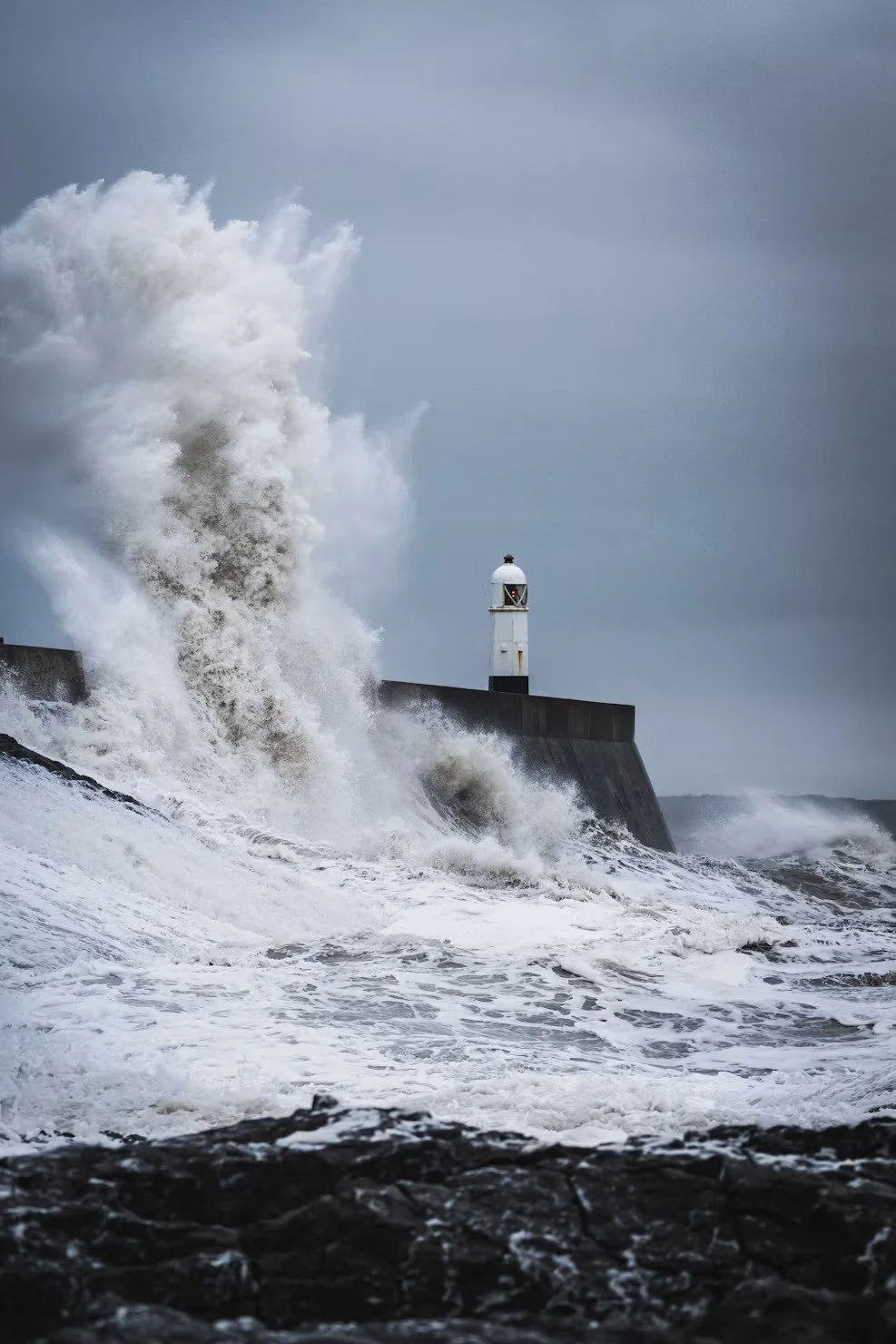
El Niño Isn't A Storm — So Why Should Dorset Care?
First, a myth to clear up. El Niño isn't a storm, and it won't turn up on the evening news with a name. It's a warming of the sea surface across the central and eastern tropical Pacific that develops every few years and nudges weather patterns around the world [2] [4].
This one is exceptional. On 22 September, the Met Office confirmed that sea temperatures in the central equatorial Pacific had passed the levels recorded in any previous event, making it the strongest El Niño on record [2]. As Professor Adam Scaife, its Head of Long Range Prediction, put it: "The fact that it has already exceeded previous records – with several weeks to go before it peaks later this year – shows the enormity of this El Niño." [2]
So what does a warm patch of ocean thousands of miles away mean for a semi in Wyke Regis? It tilts the odds; it doesn't write the forecast. The Met Office sees an increased likelihood of wetter and stormier conditions across north-west Europe, including the UK, during autumn and early winter, and an increased risk of cold snaps later in the season [2]. Its three-month outlook put the chances of a warm, wet autumn at around one and a half to two times the norm, with windier weather more likely as the season goes on — while Chief Meteorologist Ian Lisk stressed that El Niño "is only one of several factors affecting the UK's weather and it does not determine exactly what conditions we will experience." [3]
The government's scientists land in the same careful place. A roundtable of academic, industry and government experts convened by the Government Office for Science found a slightly increased chance of stronger westerlies and low pressure — the ingredients of storms, heavy rain and flooding — from October to December, and of easterlies, northerlies and cold snaps in early 2027 [4]. It also noted, refreshingly, that UK public communications about El Niño "can sometimes be misleading" [4].
So we won't tell you a named storm is heading for Weymouth. We will tell you that a stormier start to winter means more chance of fallen lines and longer repair queues — and that the best time to prepare is while the sun is out.
El Niño isn't a storm. It's a thumb on the scales.
Why Plan For Three Days?
Most power cuts are short and local, and the government's Prepare website says so — but it also warns that "more widespread and longer outages can happen", potentially lasting several days [5]. Three days is a sensible planning figure, not a scare story:
Storm Arwen, November 2021: over a million customers lost power; around 40,000 were still off after three days, and nearly 4,000 after a week [1].
Storm Goretti, January 2026: the Energy Networks Association named the South West, the Midlands and Wales as the worst-affected areas [6].
The worst case: a total, nationwide blackout has never happened in Great Britain. For that unlikely event, the government's Electricity System Restoration Standard requires the system operator to be able to restore 60% of each region's demand within 24 hours and 100% of Great Britain's within five days, by the end of this year [7].
Now the uncomfortable bit. In the government's 2025 survey of more than 10,000 UK adults, 32% said that in a power cut that also hit their gas and water, they could meet their household's basic needs for a day or less before needing outside help. Only 13% felt their household was largely or totally prepared for an emergency [8].
If you're in the 32%, this post is for you. If you're in the 13%, head straight to Part 2 — that's where it gets interesting.
The First 72 Hours
Before anyone mentions solar panels, get the basics right. They're cheap, they're quick, and the government has already written the list.
What The Government Wants In Your Cupboard
September brought a run of official nudges. At the start of the month, Environment Secretary Angela Eagle told the Guardian: "If you've got a store of a bit of food that can keep you going for a while before the emergency services can get to you, you're going to be a lot better off than if you haven't." [9] On 11 September, Defence Secretary Wes Streeting asked Sky News viewers: "in the event you have a power cut, would you know where you keep a torch? Have you even got matches or candles?" [10] And on 17 September, the Government Office for Science published its El Niño findings [4].
Full marks for the torch. On the candles, the government's own Prepare website is firmer — "torches are safer than candles" [11] — and Dorset & Wiltshire Fire and Rescue Service says not to use candles unless you have no choice [12].
Here's the official Prepare emergency kit, for an emergency lasting a few days such as a power cut [11]:
A battery or wind-up torch — torches are safer than candles.
A portable power bank for charging your mobile phone.
A battery or wind-up radio to get updates during a power cut.
Spare batteries for torches and radio, plus a backup battery for any medical equipment you rely on.
A first aid kit (or some first aid items).
Hand sanitiser and wet wipes for when the water is off.
Bottled water — the World Health Organisation recommends a minimum of 2.5–3 litres per person per day for survival; 10 litres per person per day covers basic cooking and hygiene too.
Non-perishable food that doesn't need cooking, such as ready-to-eat tinned meat, fruit or vegetables — and a tin opener. Don't forget food for pets.
Baby supplies, such as nappies and ready-to-feed formula, because you may not be able to boil water or sterilise bottles.
Prepare also asks you to keep several days' supply of any medication you need, and a few winter essentials in the car boot [11]. Then there are the jobs that cost nothing but five minutes [5]:
Write down 105 — the free number for reporting a power cut in England, Scotland and Wales — and save it in your phone.
Find your "load block" letter at powercut105.com. In the unlikely event of a national energy shortage, rota power cuts of around three hours at a time would be scheduled area by area.
Check the Priority Services Register at thepsr.co.uk, and sign up if you're eligible.
Write down the frequencies of the local and national radio stations you use for news — on paper.
Here in Dorset, the Local Resilience Forum points residents to Power Track, the live power-cut map run by SSEN, the company that runs our local electricity network [13].
To that list we'd add four things of our own: a long-reach lighter or long matches, a gas camping stove with spare cartridges (for outdoor use — more on that below), warm layers and blankets, and a little cash, because card machines need electricity too.
And about that radio. The UK Health Security Agency lists a national power outage plan among its emergency plans [14]. For that very unlikely event, the UK's four Chief Medical Officers have already written the health advice that would be broadcast — and because phone, internet and TV services would be disrupted, those emergency communications would be limited to radio [15]. The humble wind-up radio suddenly looks like the best-value item in the house.

Your Fridge Has Four Hours. Your Freezer Has Two Days.
The instinct is to start eating the freezer the moment the lights go out. Resist it. Here's the Food Standards Agency's advice [16]:
Under 4 hours without power is unlikely to affect the safety of chilled or frozen food.
Your fridge should stay cold for up to 4 hours with the door shut.
A full freezer should keep food frozen for up to 48 hours — or 24 hours if it's half full. These are estimates and models vary, so keep the door closed.
The 8°C rule. In a power cut, fridge food is fine below 8°C. Once the fridge reaches 8°C or above, eat anything that normally needs refrigerating within 4 hours — or throw it away.
Use the weather. If it's below 8°C outside, you can store food outdoors in a clean, sealed box, out of direct sunlight and away from animals.
Then eat in this order — which, handily, is also the order that wastes the least [16]:
Food that needs refrigerating.
Defrosted frozen food that doesn't need cooking.
Room-temperature perishable food.
Tins, jars and dried food.
Two tips from us. A fridge thermometer costs a few pounds and turns guesswork into a number. And since a full freezer holds its cold for twice as long as a half-empty one [16], fill the gaps with bottles of water now: they're free ice packs in a power cut, and drinking water afterwards.
Anything you can't get through in time, the FSA suggests sharing with neighbours, provided it has been stored correctly [16]. Community-minded and zero waste. We approve.
Cooking Without A Kettle
Here's the whole problem of emergency power in one comparison. The Centre for Sustainable Energy puts a typical kettle at 3,000 watts, a laptop at 50 and a broadband router at 10 [17]. Boiling the kettle draws as much power as three hundred routers. No power bank will run it, and a portable power station, if it could run a kettle at all, would be drained in minutes.
A kettle draws around 3,000 watts. A broadband router draws about 10. That's the story of emergency power in one sentence.
So in a power cut, hot food and hot drinks come from gas or wood.
Your gas hob. Electric and induction cookers won't work in a power cut, but a gas cooker may still be usable [16] — the hob, at least, because the government warns that gas ovens, boilers and heat pumps won't work without power [5]. If your hob normally lights with an electric spark, check the manual now: many can be lit by hand with a long match, but some modern hobs have electronic controls and won't work at all. And never use the hob or oven to heat the room — Dorset & Wiltshire Fire and Rescue lists "using cooking appliances as heaters" among the causes of carbon monoxide build-up [18].
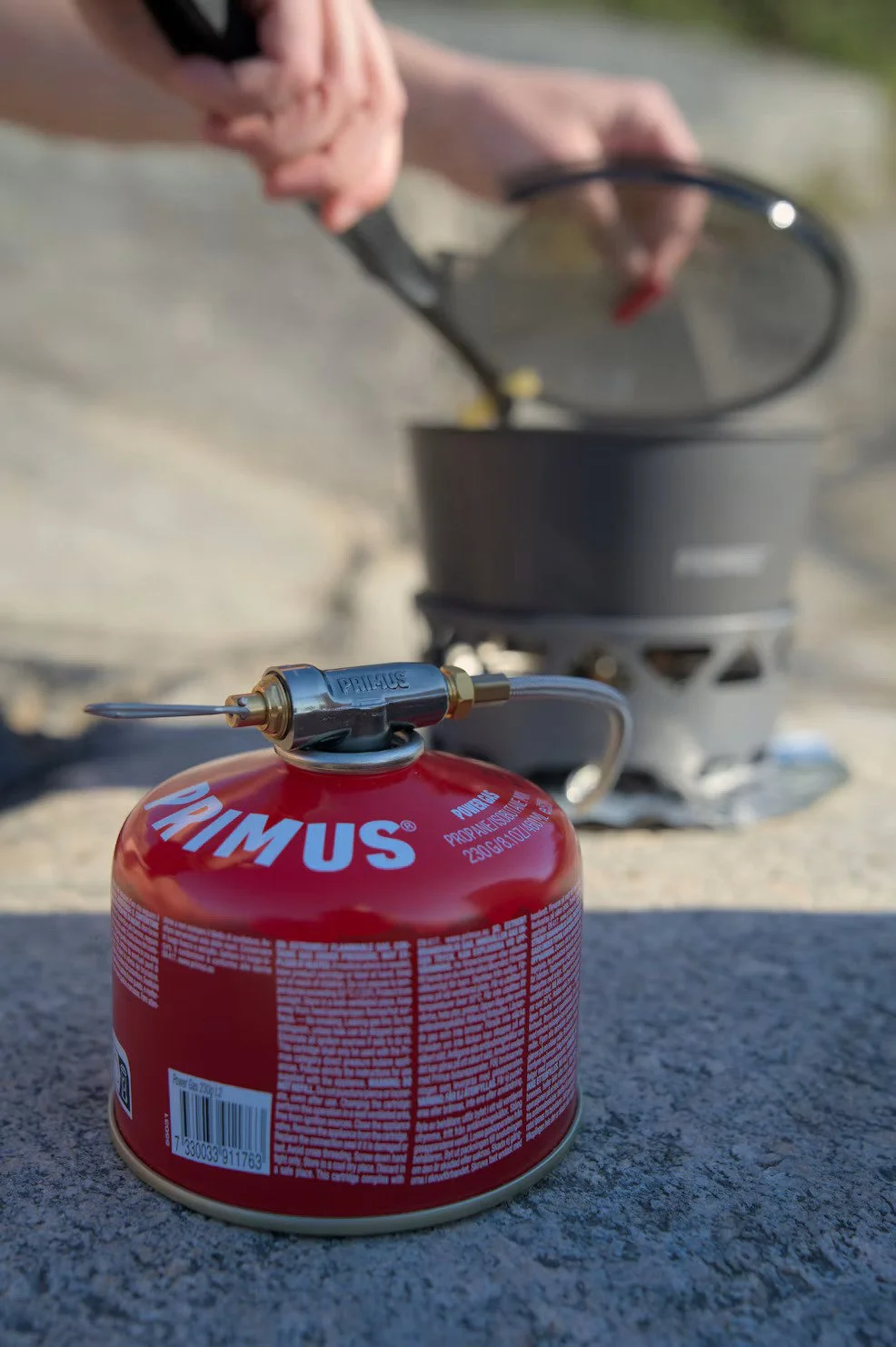
A gas camping stove — outside. This is the one people get wrong. The FSA says a camping stove, barbecue or bottled-gas stove can cook food and heat water in a power cut, but most are designed for outdoor use only [16]. The fire service is blunter: never use a camping stove, portable barbecue, lit charcoal or generator in an enclosed space, because they can produce poisonous carbon monoxide [12]. Outdoor use means outdoors — not the garage, the shed, the porch or a kitchen with the back door propped open. Set the stove on a stable surface in a sheltered spot, never leave it unattended, and change gas cartridges outside too, away from any flame [19].
Your wood burner. If you have a wood-burning stove — installed by a HETAS-registered installer and heating your living room anyway — a flat top plate can double as a hob in a power cut. Check your stove's manual first: some manufacturers are happy for a kettle or a heavy-based pan to sit on the top plate, while others advise against it. Then:
Have a carbon monoxide alarm in the same room. In England, building regulations require one whenever a new or replacement solid-fuel appliance is installed — and, since 1 October 2022, gas and oil ones too [20]. If your stove came without one, fit one anyway — Defra's stove guidance says to [21].
Never leave a pan unattended, and turn the handle away from the front of the stove.
Burn only dry, seasoned wood. Defra says dry wood has 20% moisture or less, and freshly chopped logs can take up to two years to dry [21].
No treated waste wood. Don't burn old furniture, pallets or fence panels, or household rubbish — they can give off harmful fumes and toxic pollutants [21]. We love a pallet at UIL; we just upcycle ours into shelves and tables instead.
Get the chimney swept — up to twice a year, says Defra [21] — ideally before the first cold snap.
A wood burner is also the only one of these that's meant to heat the room. Live in that room, keep the doors of unused rooms shut and draw the curtains to hold the heat in, as Prepare recommends [5].

Is any of this green? The wood burner, arguably — if the wood is local, dry and burned well. The gas, no: a camping-gas cartridge is a fossil fuel in a can, and we won't pretend otherwise. Our Green Practices page describes a "realistic and responsible approach", because "consistent, incremental improvements create far greater impact than unrealistic claims of perfection." A few cartridges kept for a genuine emergency sit comfortably inside that.
Staying Connected When The Router Goes Dark
Your home internet won't work without power, the government warns, and your mobile may stop working too if your local mast is affected [5]. Ofcom's analysis, as reported by ISPreview, found around 20% of UK mast sites have at least an hour of backup power — enough for around two-thirds of the population to make emergency calls during an outage of up to about an hour [22]. Beyond that, signal gets patchy.
Emergency calls roam. In a life-threatening emergency with no working landline, try 999 or 112 on a mobile — emergency calls automatically roam onto any available network [5].
Check your landline. If you rely on one — especially for a telecare alarm — ask your provider now whether it works in a power cut. If it won't, they may offer a free solution, such as a backup battery, giving at least an hour of emergency calls [5].
Don't use your phone as a torch. It drains the battery faster [5]. Use the real torch and switch the phone to low-power mode.
Only power the router if it's worth it. A battery-powered router only helps if the network beyond your front door still has power. In a local cut it often will; in a widespread one it may not.
The radio still talks. Try both FM and digital stations [5].
Inspired By Build It — Batteries, Scaled Down
Credit where it's due: this feature was sparked by Build It magazine. In issue 26.8 [23], sustainable construction and eco-renovation specialist Nigel Griffiths — author of the Haynes Eco House Manual — asks whether home battery storage has come of age. It's a clear-eyed read, and the sums are worth knowing:
Batteries are going standalone. Home batteries have traditionally stored daytime solar power for the evening. Now there's growing interest in standalone batteries with no solar at all: buy electricity cheaply on a time-of-use tariff, then use it when grid power costs more [23].
The tariffs. Economy 7 is the best-known. EDF's FreePhase Static splits the day into Green (11pm–6am), Amber (6am–4pm and 7pm–11pm) and Red (4pm–7pm, the national peak), while Octopus Agile follows half-hourly prices that can even go negative [23].
The payback. Nigel's worked example is a 10kWh battery costing £6,000, charged overnight at 12.5p/kWh and used to displace daytime electricity at 30p/kWh. Allowing for a 90% round trip, it saves about £1.45 a day, or £529 a year — a simple payback of 11.3 years. Allow for capacity falling by 2% a year and it stretches to around 12.7 years, against a lifespan of about 13.7 years (5,000 cycles at one a day). At £5,000 installed, payback falls to around 10.4 years; at £4,500, around 9.2 [23].
Look after it. Warranties typically run for 10–12 years, and 15 years of useful service would be a good result. Batteries that are only partially drained — say by 50% — usually last longer, and around 10% of the electricity is lost on the round trip [23].
The car on the drive. Vehicle-to-Home (V2H) — running your house from your electric car — has been trialled in the UK through projects including the government-backed FLASH programme. A home battery might store around 10kWh; an EV battery is closer to 60kWh. V2H isn't widely available yet, but it's one to watch [23].
There's one question the article doesn't set out to answer, and it's the one this winter is asking: will any of it keep your lights on in a power cut?
Often, no. Grid-connected solar panels and batteries are required to disconnect when the grid goes down. The Energy Networks Association's G98 standard for small generators includes "loss of mains" protection [24], which stops your system feeding power into lines that engineers need to be dead before they can repair them. Unless your system was specified with an emergency backup function — usually called EPS — your solar and battery will sit silently through the blackout.
The same goes for the plug-in "balcony" solar kits that became legal on 27 August 2026 [25]. The government's specification limits them to 800VA, requires the inverter to disconnect within 100 milliseconds of the mains being lost, and states that they're not intended to be used with a battery [26]. Brilliant for trimming your bills. No help at all in a blackout.
So we're going to borrow Nigel's thinking and shrink it. His battery holds 10kWh — 10,000 watt-hours. To get a household through three days of calls, news, light and a bit of laptop, we reckon you need around 400.
From a £6,000 battery on the garage wall to a box you can carry — and fill with sunshine.
Watts, Watt-Hours And Your 72-Hour Power Budget
Two units, one idea. A watt is how fast something uses energy; a watt-hour (Wh) is how much it uses over time. A 10-watt router running for 10 hours uses 100Wh. A 3,000-watt kettle gets through the same 100Wh in two minutes.
Here's our worked budget for three days, using the Centre for Sustainable Energy's typical figures for a laptop and a router [17]. A modern phone battery typically holds around 15–20Wh; to check yours, multiply its mAh rating by 3.8 and divide by 1,000.
Two phones, one full charge each a day: 2 × ~18Wh × 3 days ≈ 110Wh
An LED lantern, 3 watts, five hours an evening: 3W × 5h × 3 = 45Wh
Broadband router, 10 watts, three hours a day: 10W × 3h × 3 = 90Wh (only if the network is still up)
Laptop, 50 watts, one hour a day: 50W × 1h × 3 = 150Wh
Wind-up or battery radio: nothing from your store
Total: about 395Wh — call it 400Wh, plus a margin for conversion losses
Strip it back to one phone and a lantern and you need barely 100Wh. Add a TV — the CSE puts an LCD set at around 120 watts [17] — and every hour of viewing costs more than three days of charging two phones.
A word on power banks, because they're sold in milliamp-hours and that flatters them. A "10,000mAh" power bank stores about 37Wh at its cells' 3.7 volts, and some of that is lost converting it to the 5 volts your phone needs — Anker says an efficiency of 70–90% is normal [27]. So expect roughly 26–33Wh to reach your phone: about one and a half to two full charges, not five.
Nigel's advice applies here too: batteries last longer when they aren't routinely run flat [23]. Top up little and often. That's exactly how a solar panel, a turbine or a hand crank works best — a steady top-up, then switch off and save it for when it matters.
So how do you make 400Wh of your own? That's the subject of Part 2: sunshine, wind and elbow grease, with the honest numbers — and the kit we're buying and testing to prove it.
Your 72-Hour Cheat Sheet
Now, while the sun's out
Build the Prepare kit, write down 105 and your radio frequencies, and find your load block letter [11] [5].
Charge your power bank and phones, and keep them topped up.
Fill the freezer gaps with bottles of water.
Test your smoke and carbon monoxide alarms — the fire service recommends every home has both [18] — and get the chimney swept [21].
When the lights go out
Report it on 105, or check Power Track from SSEN [5] [13].
Unplug the TV and computer in case of a surge when the power returns, and leave one light switched on so you know when it's back [5] [12].
Keep the fridge and freezer shut, and eat chilled food first [16].
Cook outdoors on the camping stove, on the gas hob if it works, or on the wood burner if its manual allows.
Use a real torch, not your phone, and keep the phone in low-power mode [5].
Stay warm in one room, and check on vulnerable neighbours [5].
When it's back on
Check the fridge temperature before you eat anything from it — the 8°C rule [16].
Recharge everything and restock the kit.
Resilience Is A Green Habit
Here's what we like most about all this. The habits that get a household through a power cut — using less, wasting nothing, repairing and reusing, making the most of what's already around you — are the same habits that make a home greener the rest of the year. That's the thinking behind Upcycle Interiors, now in our 9th year of trading, and it's all over our Green Practices page.
Whether you're in Weymouth, Portland or Dorchester, or out on the exposed edges of our patch in Abbotsbury, West Bexington, Ringstead or West Bay, where the weather tends to arrive first, a little preparation now makes for a much calmer December. And if there's anything else around your home you'd like to talk to us about, you know where to find us. Consider it done.

Pack the kit now. Thank yourself in December.
Mark & the UIL team

Get In Touch
✨ Ready to bring your project to life? At Upcycle Interiors, we combine professionalism, trustworthiness, and reliability to deliver results you can count on.
Whether it's a small repair or a full renovation, we'll treat your home with the care and respect it deserves.
For fuss-free fixing and finishing, contact us on:
🌐 www.upcycleinteriors.co.uk/contact
📧 sales@upcycleinteriors.co.uk
📞 01305 584459
📍 Based in Weymouth and covering all of South Dorset including DT1, DT2 (part), DT3, DT4, DT5, DT6 (part). Please do get in touch here if your area is not on the list.
Upcycle Interiors Limited — professional, trustworthy, reliable.
• 4.9 ★★★★★ Across 450+ Reviews Over 9 Platforms — Ranked No. 1 In The UK
• Licensed Waste Disposal: Certificate reg. no. CBDU400611
• Full Protection: All Quotations backed by a contract
• Warranty: Work protected by 1 yr. Defect Liability Period
• All staff DBS checked, certificates available upon request
• All work insured (up to 4 people) Axa policy No.TP1036224
• A small 10% deposit secures your project in our pipeline
• VAT No. 483072978
• Company No. 11641998
References
[1] https://www.ofgem.gov.uk/research/storm-arwen-report
[2] https://www.metoffice.gov.uk/blog/2026/record-breaking-el-nio-surpasses-previous-benchmarks-
[4] https://www.gov.uk/government/publications/impacts-of-el-nino-on-the-uk/impacts-of-el-nino-on-the-uk
[5] https://prepare.campaign.gov.uk/be-informed-about-hazards/power-cuts/
[6] https://www.energynetworks.org/newsroom/storm-goretti-power-cut-information
[9] https://www.lbc.co.uk/article/brits-stock-up-on-supplies-el-nino-5Hjdgxw_2/
[10] https://www.aol.co.uk/articles/defence-secretary-friday-warning-tells-072000000.html
[11] https://prepare.campaign.gov.uk/get-prepared-for-emergencies/
[12] https://www.dwfire.org.uk/safety/storms-and-power-cuts/power-cuts/
[13] https://dorsetprepared.org.uk/types-of-risk/power-outages
[17] https://www.cse.org.uk/advice/how-much-electricity-am-i-using/
[18] https://www.dwfire.org.uk/safety/safety-at-home/carbon-monoxide/
[19] https://www.firescotland.gov.uk/at-home/power-cuts/
[21] https://uk-air.defra.gov.uk/assets/documents/reports/cat09/1901291307_Ready_to_Burn_Web.pdf
[23] https://www.self-build.co.uk/publication/26-8/
[24] https://dcode.org.uk/assets/250307ena-erec-g98-issue-2-(2025).pdf
[25] https://www.legislation.gov.uk/uksi/2026/848/made
[27] https://www.anker.com/ca/blogs/power-banks/how-to-check-capacity-of-power-bank
Disclaimer
This article is for general information only. It isn't professional electrical, gas or fire-safety advice, and every home, appliance and product is different. Always follow the manufacturer's instructions and the official guidance from the government, the Food Standards Agency and your fire and rescue service, and use a qualified professional for any installation or electrical work. Anything you do with the information or products in this article is at your own risk: to the fullest extent permitted by law, Upcycle Interiors Ltd cannot accept responsibility for anyone's safety, or for any loss, damage or injury arising from its use. In an emergency, call 999.
