

Water Always Wins
The damp patch on your ceiling didn’t start on your ceiling — it started outside, months ago.
Here’s how it usually goes. A faint brown ring appears on a bedroom ceiling. You tell yourself it’s old, or it’s condensation, or it’ll dry out on its own. A few wet weeks later it’s bigger, darker, and there’s a smell. By the time water shows up on the inside of your home, it has already been getting in for a long time — and it has taken the scenic route through your roof timbers, your insulation and your plaster to get there.
Almost none of these problems begin where you notice them. A damp wall is often a blocked gutter. A stained ceiling is usually a slipped tile or tired & weather-beaten lead. A musty corner can be a single perished joint in a rainwater pipe two floors up. The cause is sometimes small, simple and easy to ignore. The consequence, left long enough, is none of those three things.
This blog isn’t a single project. It’s a look across the kind of exterior maintenance we’re called out for week in, week out across Weymouth, Portland and Dorchester — roofing, gutters, rainwater systems, flashings, bird proofing, and the water ingress that ties them all together. Different roofs, different streets, same lesson: outside is where this fight is won or lost.
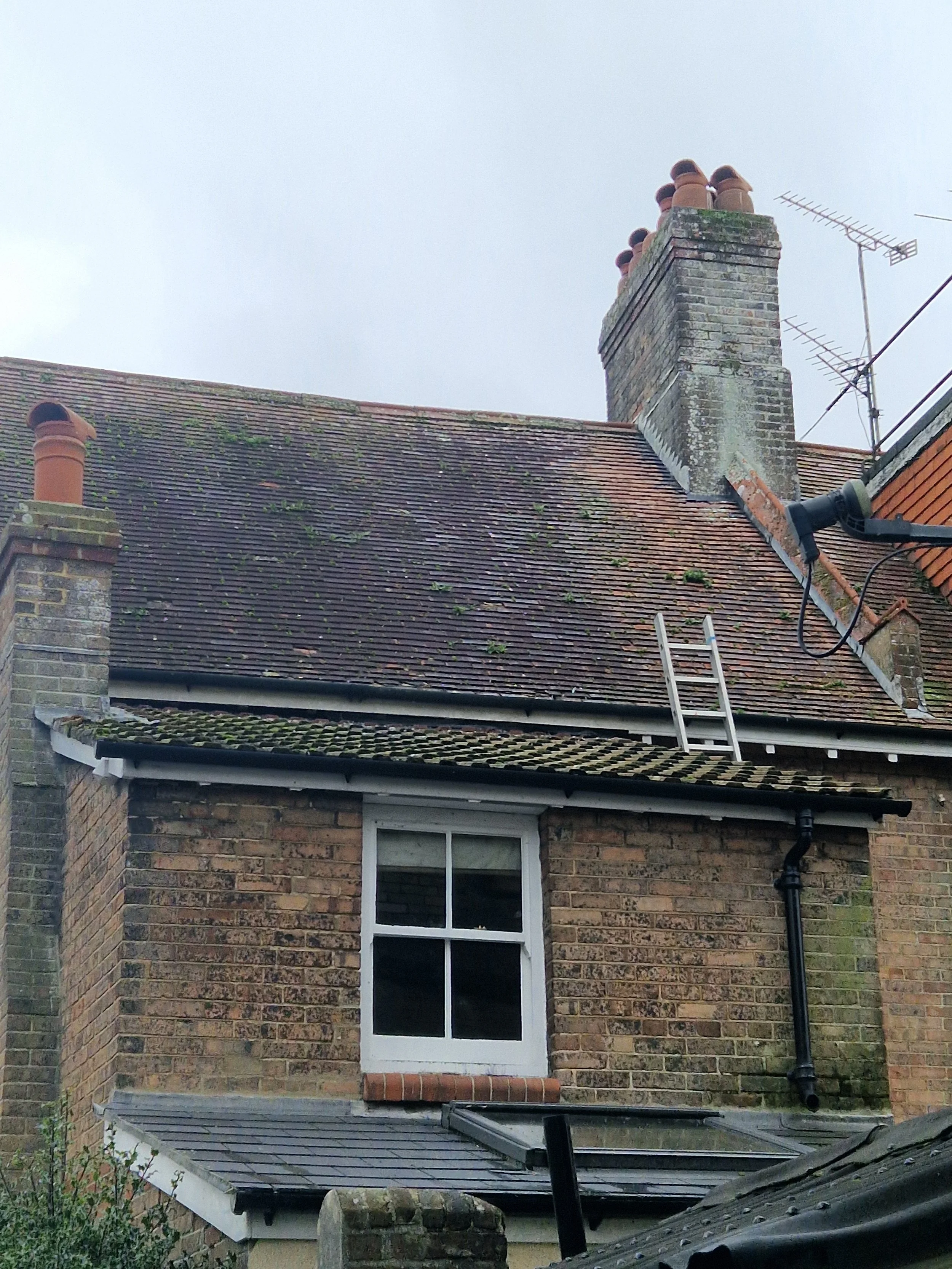
A characterful South Dorset roofscape.
It Starts Outside
The outside of your home has one job: keep the weather where it belongs. Roof covering, ridge, flashings, fascias, gutters, downpipes, pointing — none of them work alone. They are a single system, and like any system it is only as good as its weakest part. One failed component doesn’t stay one failed component for long; it quietly loads the next one along until something gives.
The trouble is that this system lives where you never look. You see your kitchen every day. You see your ridge line perhaps never. So the first honest piece of advice we give anyone is simple: look up occasionally, or get someone to look up for you. A ten-minute inspection from a ladder or a drone costs nothing like a ceiling repair, a re-plaster and a fortnight of dehumidifiers.
The UIL approach to property maintenance1 is planned rather than panicked. We would far rather spot a cracked verge tile in October than meet it as a damp diagnosis in January. Our team is DBS checked, fully insured, and works to fixed, written quotations — so when we tell you something needs doing, you get a clear price for doing it, and an equally clear steer on the things that genuinely don’t.
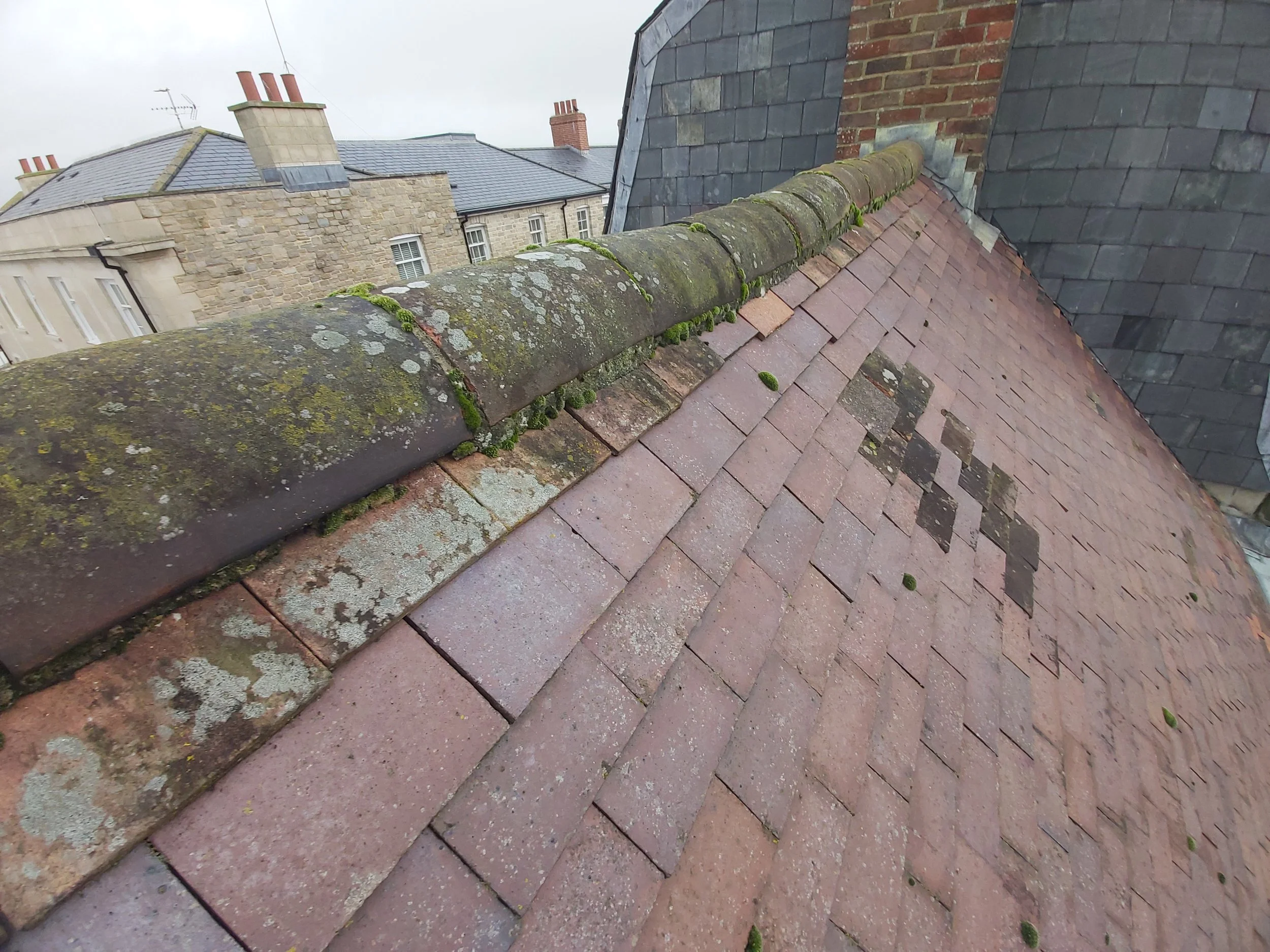
Original ridge and clay plain tiles, heavily colonised by moss and lichen — picturesque, but a sign the surface is holding moisture it should be shedding.
The Roof Over Your Head
Roofs tend to fail the way the man in the old joke goes broke: gradually, then suddenly. For years a roof sheds water without complaint while, out of sight, the nails holding the tiles slowly corrode — what the trade cheerfully calls nail sickness. Mortar bedding under the ridge dries, shrinks and cracks. Lead flashings around chimneys and valleys lift and fatigue. None of it is dramatic. Then one gusty night moves a few tiles, exposes the felt or batten beneath, and the weather finally gets in.
On older and period properties the stakes are higher and the rules are different. Handmade clay tiles, lime mortar and lead detailing were designed to move, breathe and be repaired — not stripped off and swapped for the nearest modern equivalent. A sympathetic repair keeps the building watertight and keeps its character intact. A clumsy one stores up damp problems and, on a listed building, can land you in bother besides.
Most of what we do up there is unglamorous and important: re-bedding ridge tiles, replacing slipped or cracked units, renewing tired flashings, re-pointing where the mortar has given up. Caught early, it’s a morning’s work. Caught late, it’s the morning’s work plus everything the water reached on the way down.
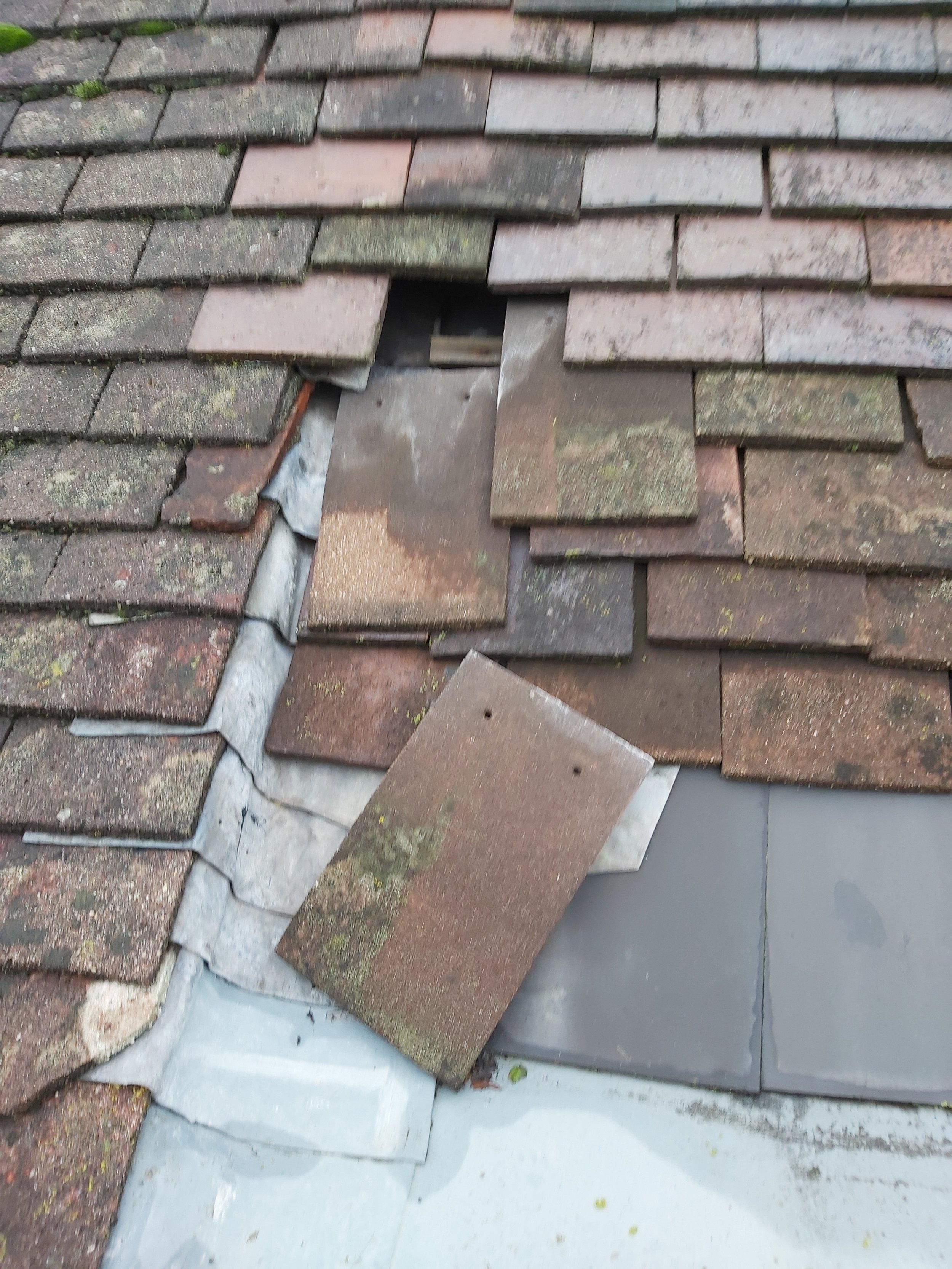
Slipped and lifted tiles over lead flashing. With the covering broken like this, every shower has a direct route to the timbers below — textbook water ingress.
Old Tiles, Worth Keeping
There is a reflex in this trade to rip everything off and start again, because new is quicker to quote and easier to guarantee. We are not fond of it. When a handful of tiles slip on an otherwise sound roof, the answer usually isn’t a skip and a fresh batch of factory tiles that will never quite match — it is careful salvage, sorting and re-laying, topped up with reclaimed tiles of the right age and colour.
This is where the upcycling in our name earns its keep. Reclaimed clay tiles are not a compromise; they are often better than what you would buy new. Take the one in the next photograph. Turn an old plain tile over and you will frequently find a maker’s mark pressed into the clay — this one reads HAWKINS, CANNOCK, a Staffordshire tileworks. That tile has very likely been keeping rain off a Dorset family for the best part of a century, and it has comfortably outlasted the nails that were holding it. Properly re-laid, it has decades left.
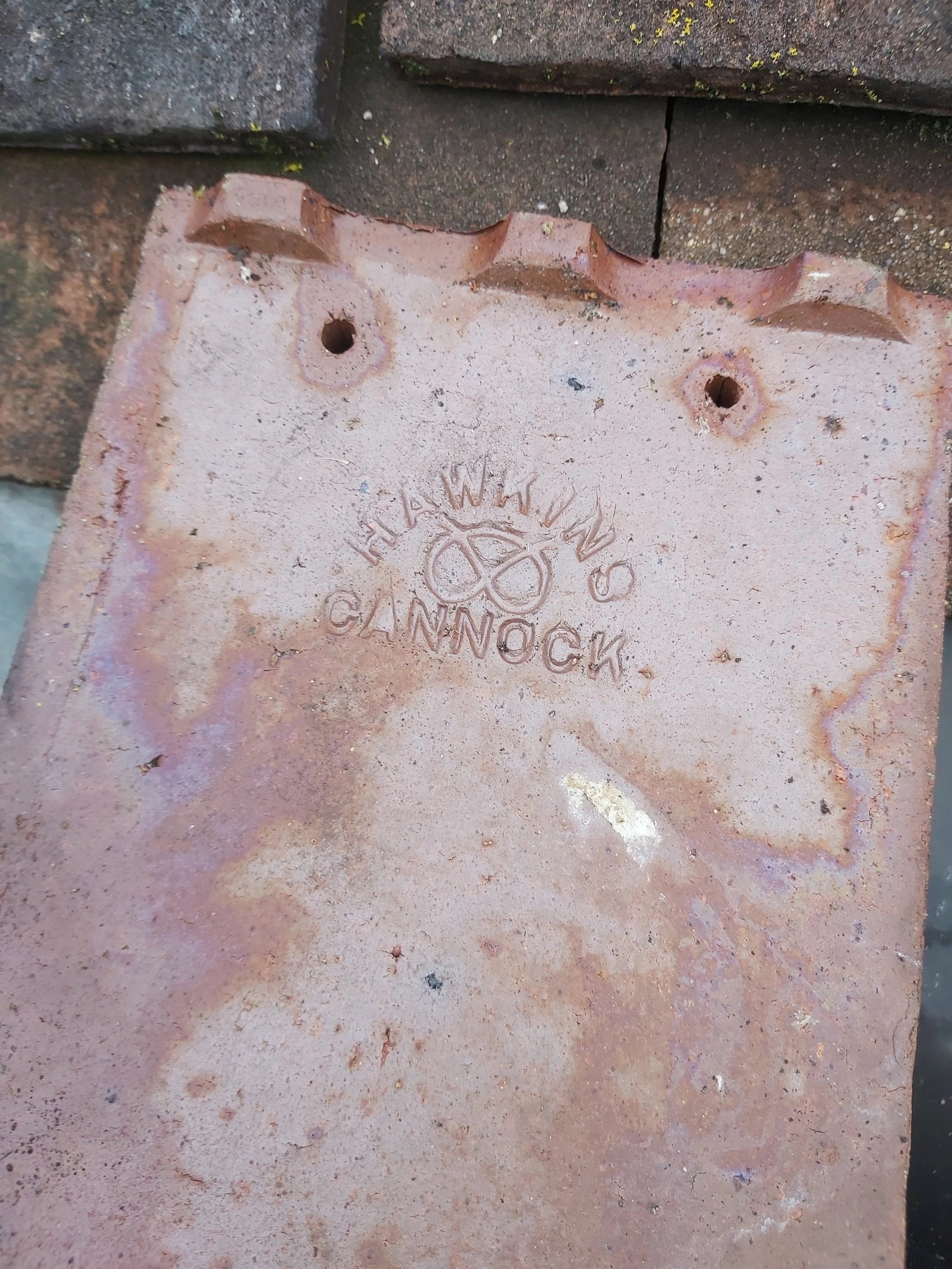
A maker’s mark — HAWKINS of CANNOCK — pressed into the back of a reclaimed clay tile. Decades old, and still perfectly serviceable.
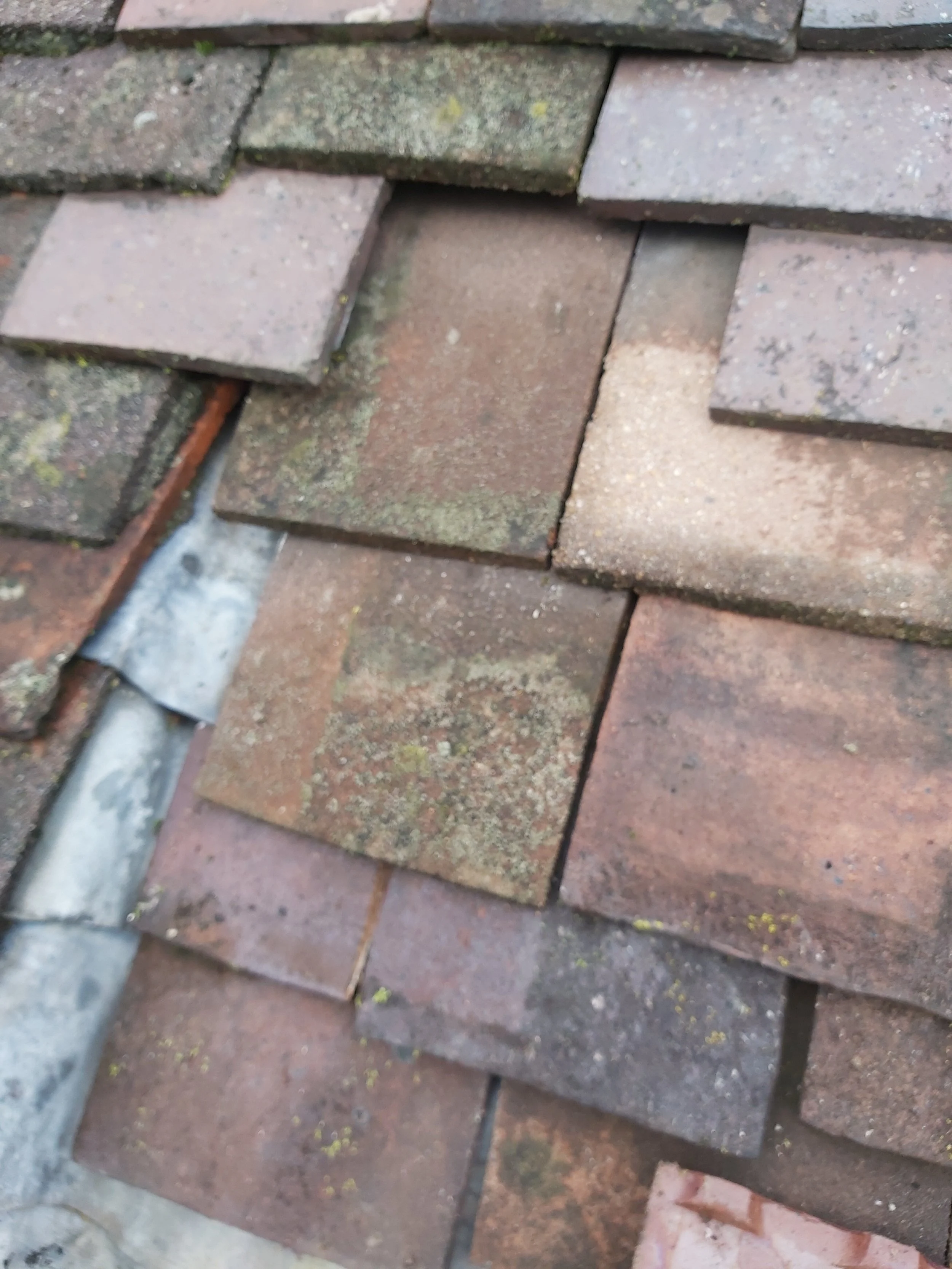
Sorted clay tiles showing the natural colour variation that makes a period roof look right — and makes cheap new replacements stand out a mile.
Gutters, Downpipes And The Water You Never See
If the roof is the part everyone worries about, gutters and downpipes are the part everyone forgets — right up until they don’t. Rainwater goods exist to catch everything the roof sheds and carry it safely away from the building. When they are blocked, split, sagging or badly joined, they do the exact opposite: they deliver water straight down the wall, behind the render, into the pointing and, eventually, indoors.
The symptoms are easy to read once you know them. A green streak down brickwork. A patch of wall that is always damp on one side of a downpipe. Frost damage to mortar that keeps returning in the same spot. More often than not the fix is undramatic — clearing a season’s worth of leaves and moss, re-aligning a run so it actually falls towards the outlet, re-sealing a joint, or swapping a perished hopper or length of pipe. On period homes we will repair and keep cast iron where we sensibly can, rather than reaching for plastic by default.
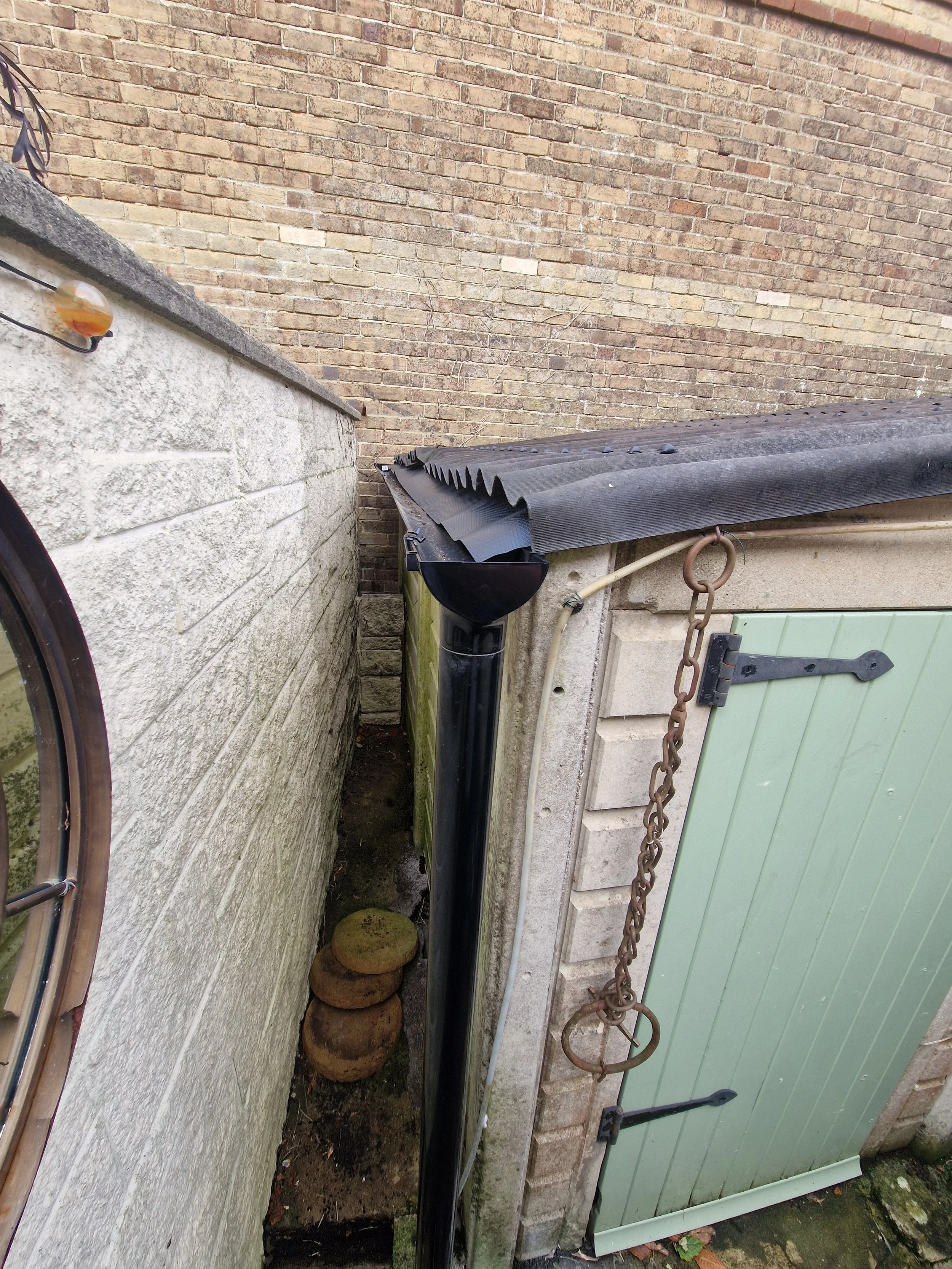
A gutter and downpipe serving an outbuilding — the unglamorous “plumbing” (yes - gutters were installed by plumbers many years ago!) that decides whether rainwater leaves your walls or soaks into them.
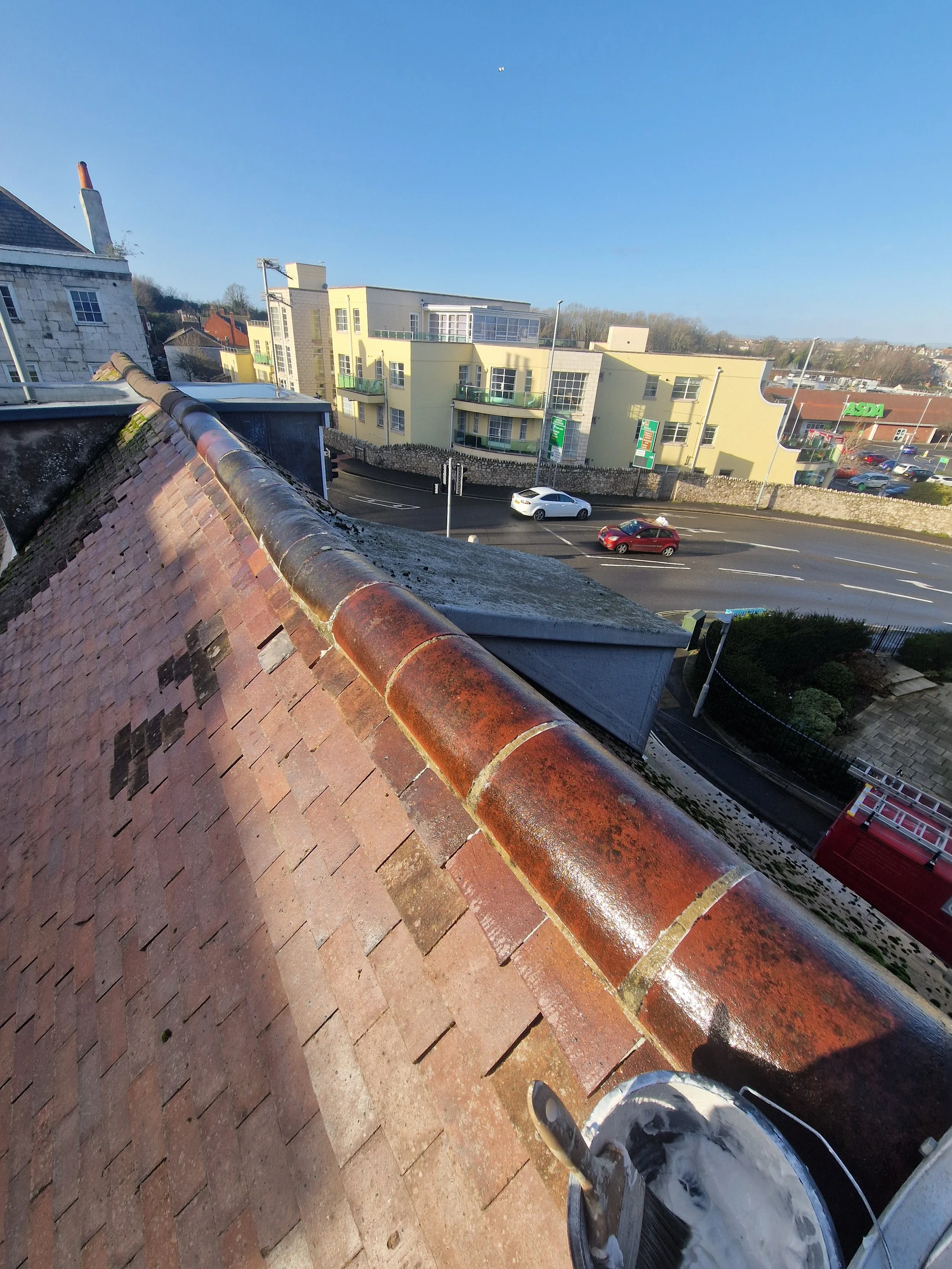
Ridge repointed above a busy Weymouth junction.
Birds In The Works
Birds are lovely to watch and considerably less lovely once they have moved into your roofline. Gaps under eaves, behind fascias and beneath slipped tiles are prime nesting real estate, and a nest in the wrong place blocks gutters, traps moisture against timber, and props open the very gaps that let the weather in. Solar panels, with their warm sheltered cavity underneath, are a particular favourite.
The answer is humane exclusion rather than anything dramatic: discreet wire mesh, proofing and the occasional spike, fitted so the birds simply go elsewhere and your roofline stays clear. Done sympathetically, you barely see it from the ground — which matters a great deal on a period or town-centre building, where a heavy-handed job would look worse than the pigeons ever did.
This is what our client said –
“High standard of work, excellent communications from initial enquiry through to quote and the work itself. Went the extra mile to solve our problem (with pigeons in the roof) and displayed good initiative solving a drainage issue. Very impressed and would use again. Thanks!”
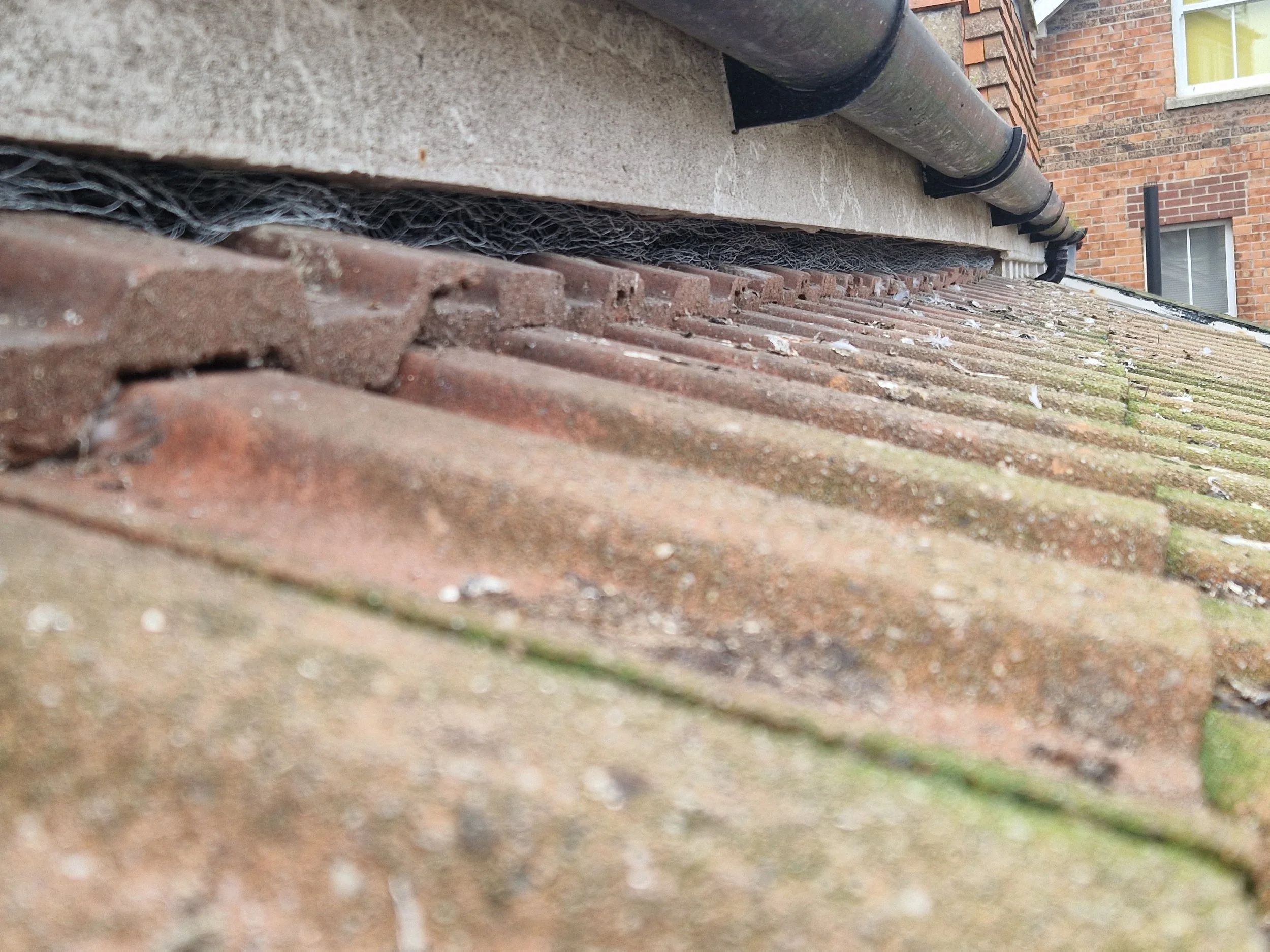
Bird mesh fitted along the eaves to keep nesting out of the facia line — discreet from the street, decisive up close.
Why It Pays To Catch It Early
Everything above comes back to the same piece of arithmetic. Water ingress does not stand still. Today’s slipped tile is next month’s damp batten, next winter’s rotten rafter end, and next year’s blown plaster, ruined insulation and nervous conversation with an electrician about a wet ceiling rose. Each stage costs several times the last. The single cheapest moment to deal with any of it is always now, while it is still a job on the outside and not a project on the inside.
None of this requires you to become a roofing expert. It requires someone reliable to look, tell you the truth about what they find, and fix what actually needs fixing. That is the whole job. Our clients tend to find us through recommendation and stay through results — and they are happy enough to say so in public. We will take “they turned up and did exactly what they said they would” over any amount of marketing.
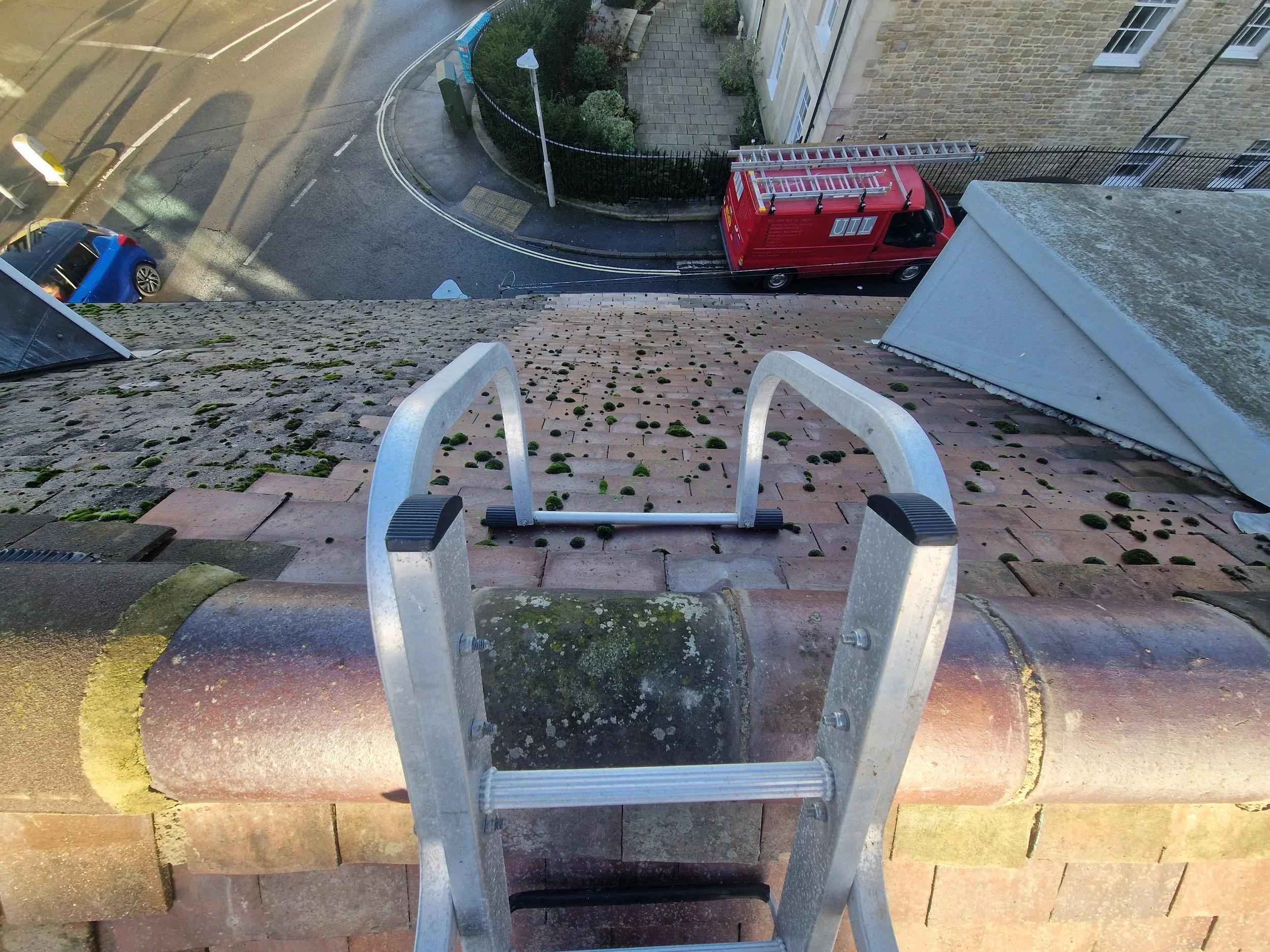
The UIL van on a Weymouth street, seen from the ridge we were working on – like a little toy car.
If something on the outside of your home is letting the weather in — a slipped tile, a tired gutter, a damp patch that keeps coming back — it will not mend itself, and it will not get cheaper for waiting. Send us a few photos or book a look. You’ll get a straight assessment and a fixed-price quotation from a team that treats your home, old or new, with the care it deserves.
Water always wins in the end. Our job is to make sure the end stays a very long way off.
Get In Touch
Ready to tackle the maintenance you’ve been putting off? At Upcycle Interiors, we combine professionalism, trustworthiness and reliability to deliver results you can count on.
Whether it’s a small repair or a full renovation, we’ll treat your home with the care and respect it deserves.
For fuss-free fixing and finishing, contact us on:
Web: www.upcycleinteriors.co.uk/contact
Email: sales@upcycleinteriors.co.uk
Phone: 01305 584459
Based in Weymouth and covering all of South Dorset including DT1, DT2 (part), DT3, DT4, DT5, DT6 (part). Please do get in touch if your area is not on the list.
Upcycle Interiors Limited — professional, trustworthy, reliable.
Fully insured | DBS checked | Written quotations | VAT No. 483072978 | Waste Carrier Licence CBDU400611 | AXA insured
References
1 UIL Property Maintenance service — https://www.upcycleinteriors.co.uk/maintenance
2 Upcycle Interiors client reviews (Google) — https://maps.app.goo.gl/pVUDzkeF2nGFvyALA
