

How Much Do We Charge? The Hourly Rates of a Bonafide Limited Company — EXPOSED
The real numbers. Laid bare. No hiding.


Who This Guide Is For
You’ve had three quotes. They’re all different – in this guide we will explain why.
One company has a smart website, a detailed quote with written contract, and a team of DBS-checked staff. The second is a bloke who answered after you called him 3 times and sounded like he was half asleep – his number was passed to you by a friend of a friend. The third company sound half decent, you found their Facebook page, but they don’t have a website, you spoke to them on Thursday they can start Monday. All 3 are offering to do the same job.
This guide exists because those gaps needs explaining. Not defending - explaining. The financial figures you will read in this article are real, they are ours (individual to us), and by the time you've read them you'll understand exactly where your money goes when you hire a legitimate limited company - and exactly what you're not getting when you don't.
So, to those people who just want to drive a price down or get the cheapest price – this blog isn’t for you.
For anyone who may have debated online in a “Screwfix internet forum” or on Facebook that an employee has the same running costs as someone self-employed… The figures below will prove otherwise - we are yet to find an employee who has to pay for his or her own waste… or did we forget that one time we were asked to take a boot full of rubble home?…. (for free!)
To the other business owners and the people who simply get it — you already know what running a legitimate operation actually costs. You don't need this guide but please do share this information with other people who do need it (and go on….have a read anyway – it’s always nice to talk to other people in the same boat).
For our competitors – fill your boots. If you’ve got a genuine business, then you will already know your numbers inside out. We would bet our bottom dollar that if your company is a similar size to ours then your prices won’t be far off either (we see them on a regular basis). We’d love to hear from you!
Why We’re Publishing This
The intent of this blog is to lift the industry and help. If you’re in business and your numbers are way off ours then we hope these calculations are a valuable learning tool for you. It will open your eyes to some “stealth” costs that you hadn’t realised are undermining your business –
every single day.
Those silent costs are stealing from you every day without you knowing it! We want to help you realise why every month and every year you don’t make as much as you thought you were going to – we see it day in day out, other tradespeople just try to work harder and longer to dig themselves out of a financial rut. They all believe –
“Just one more job will make us!”
“The next job will be our breakout.”
“If we can just do one more, we will have made it.”
That’s not how it works and it never will… sorry!
(If you are a one-man-band and want to calculate your own hourly rates we suggest using a figure of around 1,169 billable hours per year. This allows for more than one day a week to spend on quotes, admin, site visits, etc. We no longer use this figure as our business has outgrown it, but if you’re struggling with your numbers then this is a realistic starting point.)
Understanding Why Our Price Is What It Is
To those people who are genuinely interested to understand why our price is so “high” – hopefully this detailed and thorough guide will demystify why we charge more than someone who is employed (employed rates vs self-employed one-man-band rates vs business rates… they’re all incomparable, as you will soon see).
All businesses are different and everyone’s individual situation is different. A sole trader is entirely different from a limited company team. And “employed” work is so different from “self-employed” work that they are in different stratospheres! We charge what we need to charge to sustain our business and thrive. We want to write this guide to expose the industry because undercutting never works. We want to teach our fellow people so they can grow and better themselves too.
Most importantly, we want to teach our future clients that if a “self-employed” person offers something that is too good to be true then it probably is. Our entire business was born from the frustration of finding professional, trustworthy and reliable tradespeople. We were stung more than once and we have been the victim of cowboy tradespeople too - we don’t want you to be stung as well.
The Small Print – Before We Get Into the Numbers
• These prices were calculated in 2025.
• Prices and costs are always fluid. The exact time and date for this guide to go live is unknown and immediately after publication these numbers will be wrong. Business overheads and expenses change (by the day and by the hour) while the business is trading. For this reason, we calculate everything “live” and all calculations are linked. Please don’t think that we actively use this static guide for our calculations. Figures (such as six pence for stationery) are only correct at the moment in time when they are calculated.
• UIL is in its 8th year of trading and has 5 members of staff. Some wages are non-productive (that is to say, the work they do does not directly generate income – for example, administration time to fill in staff timesheets vs a carpenter making a shelf). For this reason, the figures below must be “taken with a pinch of salt”.
• We don’t charge for quotes – but as a business with staff, that time still needs to be paid for from somewhere (we discovered that no one will work for free!). The hourly rates below are not “static” – for example the wages have been simplified. This was necessary to fit this information into a guide that wasn’t 51 pages long.
• Our figures are calculated at approximately 95% efficiency rate (which is optimistically high / borderline impossible!).
• None of the costs below cover Dividends as these are not allowable expenses. Dividends are paid after tax.
• This guide is solely about labour, not materials – that is a subject for another day.
• These calculations are based on around 232 working days in a year. If you think this is wrong, please look it up – we don’t work 365 days in a year. We don’t even work 260 days in a year – no one does. It would be foolishly optimistic to base our calculations on 365 or 260.
The Numbers
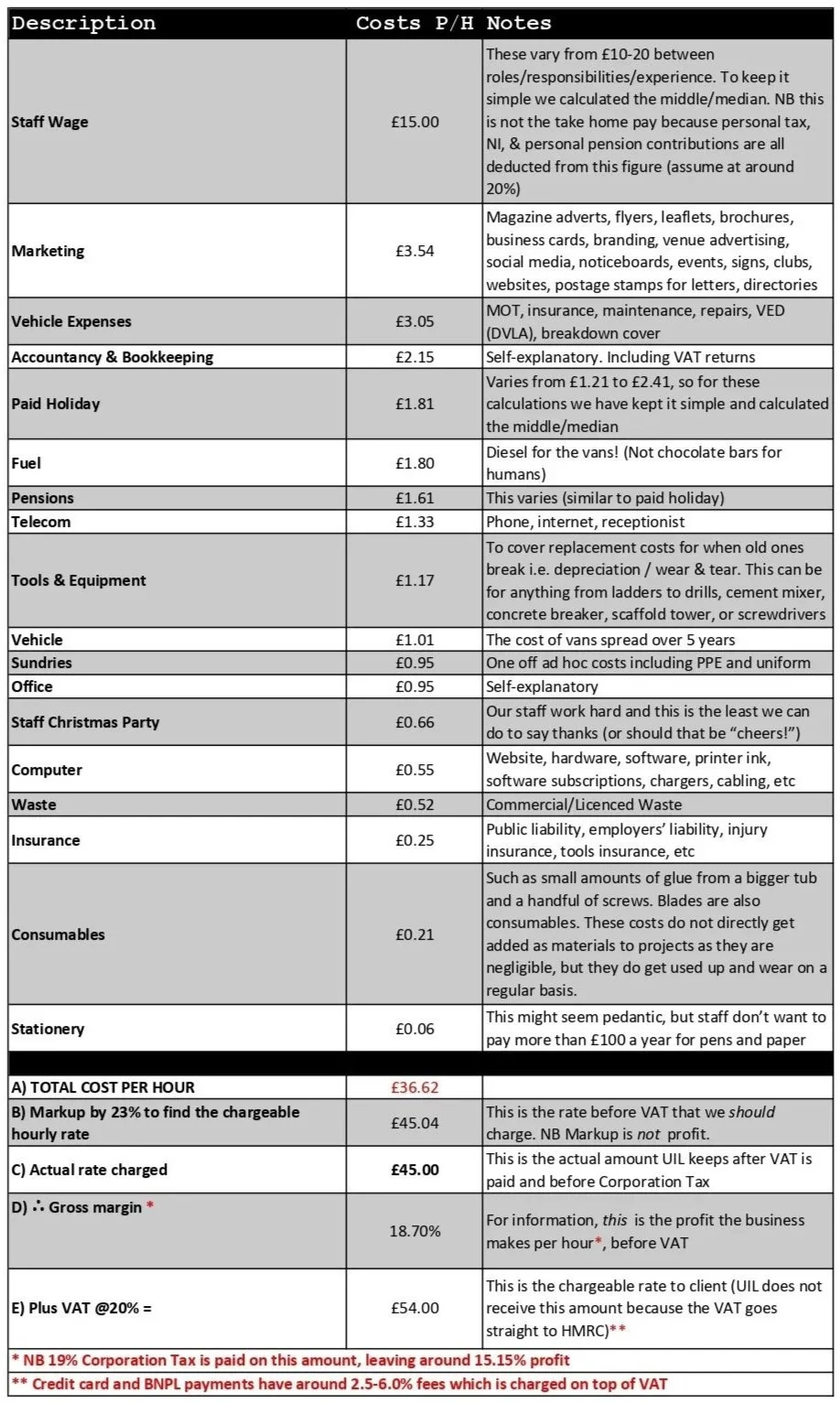
So There You Have It
Now you know our hourly rates and how much we need to charge to “stand still”. You can see all our overheads laid bare – we have nothing to hide. You can see where the money goes, who to, and most importantly – why!
A Dirty Word: Profit
The next question you must surely be asking yourself right now is regarding a dirty topic… profit!
That’s right – we aren’t a charity or “not-for-profit”. We aren’t a community organisation and we don’t have volunteers. We do enjoy our work, but we don’t do it for fun as a hobby. We mentioned above that these are the figures we need to “stand still”. The astute readers will have clearly noticed that there is some profit (18.7% in the figures above). But this is the gross margin – when we make profit we pay corporation tax at 19%. So the 19% tax off of our 18.7% gross margin leaves us with around 15.15% net profit.
We need that 15% profit. The business needs that profit.
It’s healthy & sustainable.
The profit is for us to grow and reinvest. It is for a new van, investment for new staff, for training, and for unexpected costs. It is also our safety net – for surprises, rainy days, when jobs get cancelled at short notice, or when things go wrong. Without it the business cannot weather the storm, and we wouldn’t be there tomorrow to help our loyal clients.
But Dave From Down the Pub Is Half Your Price…
If you’re still reading this guide and you’ve made it this far then well done and thank you – we think this subject is important and you probably do too! For us, these numbers are why we start work early every morning and stay working late into the night. We are passionate about this stuff.
You might still be thinking “OK, I can see your costs and now I do understand why you aren’t £20 per hour… but I am still tempted to go with Dave from down the pub because he is half your price!”
Consider this first - Dave’s price isn’t “real”.
We have heard so many stories about someone verbally saying “they can do it for less” – but they never actually turn up!
If you’re still tempted to go with Dave, before you do, consider these questions:
When will they actually turn up? (if ever?)
Have they actually committed to a legally binding fixed price quotation and provided a contract too? (or are you proceeding on an estimate which isn’t worth the paper it’s written on?)
Will they add surprise “extra” costs to their “estimate” to cover the sundries and consumables they forgot about?
Are they illegally fly-tipping your commercial waste? (That you are responsible for! Even taking it to the Household Recycling Centre AKA “The Tip” is illegal.)
Are they going to ask you for extra fuel money and money for their lunch at the end of the week? (You may laugh but this was a real conversation we had with a cowboy builder in 2018!)
Will they return your phone calls, or has their phone run out of credit/data… again…!
Do you care that they don’t have any holiday pay or pension?
Will they still be around to help you tomorrow if their vehicle breaks down?
We left the best till last because it is the single most important item on this list – if they don’t have an accountant or bookkeeper, are they genuinely submitting their own tax returns every year? Or are you paying in cash… and all those thousands of pounds of taxes that should be helping to pay for schools and hospitals, soldiers and firefighters, potholes and pensioners are going straight into their pocket!?
The Factor Nobody Talks About: Speed
The final factor to consider when comparing labour rates is speed. Is an experienced builder who charges £400 per day and completes a task in one day actually expensive compared to an inefficient labourer who charges £200 a day but does everything in the wrong order and completes the task in two days? (Notice we are not discussing quality of workmanship – only efficiency and speed.)
Speed is a very, very important factor.
We encourage you to judge us.
So as you can see, when analysing labour rates speed is a critically important factor. We welcome your questions on this topic (estimates, quotes, and paying per hour have all been covered in this guide here previously).
Apples With Apples
After you have carried out your due diligence and satisfied yourself that you are comparing apples with apples (and eliminated “Dave” who conveniently only takes cash…) we would finally prompt you to consider – if Upcycle Interiors has similar costs to other businesses but still looks more expensive, is it because UIL might be:
Slow?
Inefficient?
Thorough?
Inexperienced?
Providing a better reliable service? (read more here)
Communicating and responding to emails and phone calls?
Spending more time on site visits and detailed written quotations (not verbal estimates)?
Making profit for the business?
Disorganised?
Not working hard enough?
Acting professionally and not cutting corners?
Comparable Rates – For Reference
To put our rate in context, here are what other professionals charge across the same region:
Specialist Asbestos Removal: £44 per hour + VAT
Plumber (not gas): £75 per hour + VAT
Plumber (Gas Heating Engineer): £66 per hour + VAT
Electrician: £75 per hour + VAT
Drain Unblocking: £100 per hour + VAT
Local Motor Garage: £100 per hour + VAT
LONDON - Builder £120 + VAT per hour
Checkatrade (2023/24) suggests builders charge around £40–50 per hour: checkatrade.com/blog/cost-guides/builder-day-rate. At least a year out of date.
Checkatrade (written in 2026, though based on 2024 data) suggests handymen charge £30–50 per hour: checkatrade.com/blog/cost-guides/handyman-prices. At least a year out of date.
This article includes comparable rates from a large company for appliance and TV installation: read here.
To read more about understanding your quote, take a look at our guide: understanding your quote.
For further reading, check out our reltated blog post here: How Much Should a Tradesperson Charge Per Hour? Why £15 Doesn't Add Up

Professional
We are not the cheapest option in Weymouth. We have never tried to be. What we are is: Trading Standards Approved, insured, DBS checked, VAT registered, licensed waste carriers, and — most importantly — we turn up. We answer the phone. We do what we said we would do.
That is worth something. These numbers explain what.
Areas We Cover
We serve homeowners, landlords, and property professionals across Weymouth, Portland, Dorchester, Poundbury, Puddletown, Bridport, Wool, and the wider DT postcode area: DT1, DT2 (part), DT3, DT4, DT5, and DT6 (part).
Telephone: 01305 584459
Email: sales@upcycleinteriors.co.uk
Upcycle Interiors Limited — From Reliable Repairs To Full Renovations.
~ No Half Measures ~


£15 an hour. That was the figure being thrown around on a well-known social media platform — not Facebook — where customers were openly debating what tradespeople should charge. £15 an hour, or £130 a day, was being described as a perfectly acceptable rate.
Let’s make one thing absolutely clear: no legitimate tradesperson in 2026 can charge £15 an hour. That rate is virtually identical to the National Minimum Wage. And that’s the crux of the problem — people are confusing a business rate with a take-home wage. They are not the same thing. Not even close.