

Earth As A Contemporary Building Material
Article first written Tuesday 13th December 2005
I have chosen to write about adobe because I think it is the most suitable earth building method for the United Kingdom to adopt. During this essay I will explain why it is the most practical and efficient building technique for the UK’s contemporary construction industry.
Adobe’s roots can be traced back to north and west Africa. The Moorish Islamic empire spread up to Spain, which then moved over the Atlantic.[1]
The word Adobe is Spanish and means “sun dried earth brick”,[2] it is also known as clay lump, cobb bricks, mud bricks or mud blocks. See Figure One for an example of early Pre-Spanish adobe architecture.
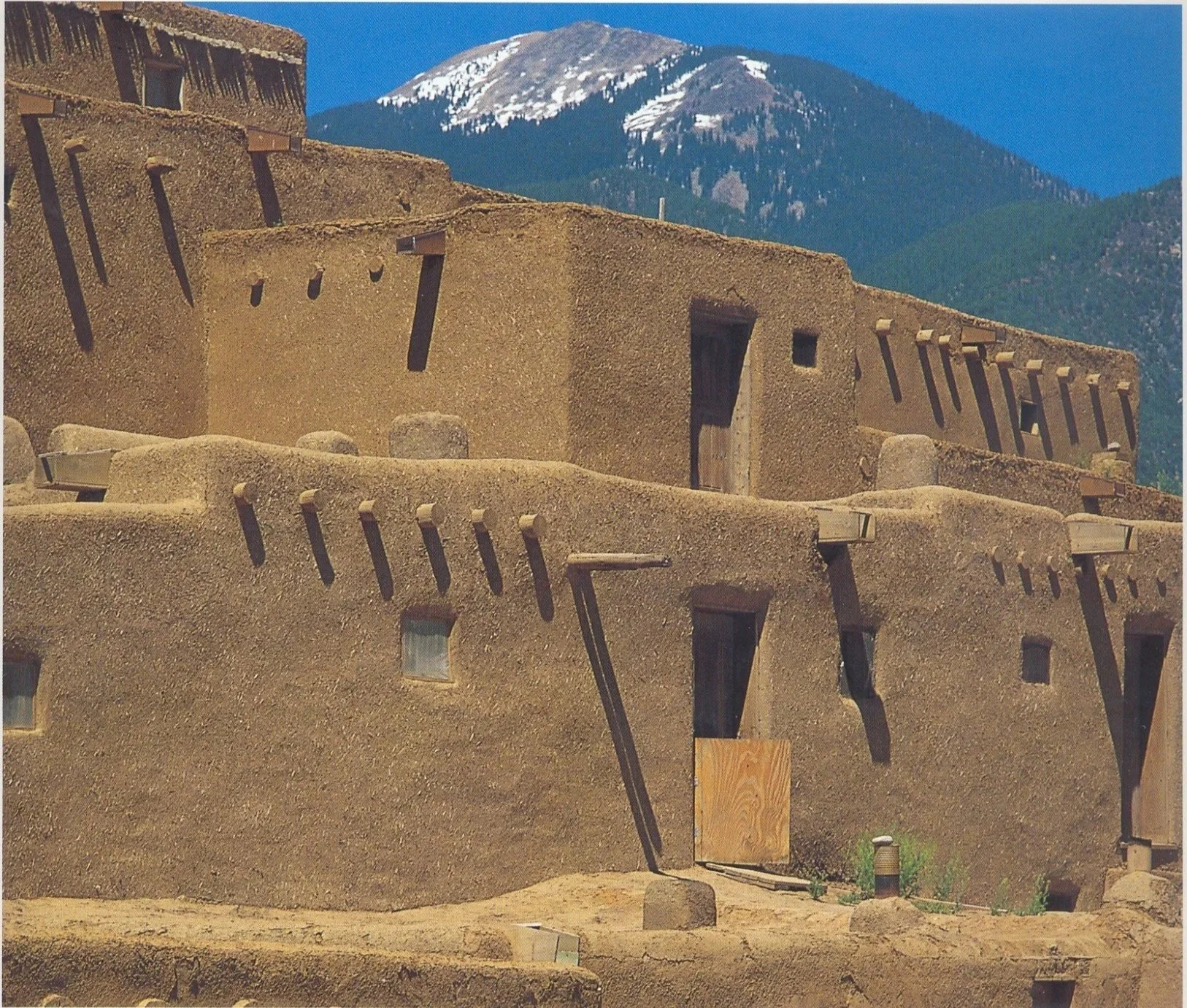
FIGURE ONE – Taos, early adobe building[3]. Note the exposed wooden beams, these are used to attach scaffolding for regular repair of the walls (every 2 years or so).
Mud bricks are the most common and versatile way of using soil to build. Over centuries they have been used to build almost every type of building and in pretty much every region of the world. Adobe buildings include fortresses, palaces, tombs and temples.[4]
Adobe is made up of clay, earth and sand, sometimes straw is added. Sand is not a requirement, but is normally present. Sometimes a stabilizer such as bitumen, cement or lime is added, but this is not necessarily needed. In America there are building codes to specify the amount of silt-clay to be added to an earth mixture; it is to be between 25% and 45%. Straw is not always used, but is quite advantageous, it acts as a reinforcing element to stop cracking during shrinkage, also it will make the finished brick lighter (in weight) and more insulative; a good straw to earth ratio is 2:5.[5]
Adobe is the ideal material for the beginner. No previous skills are needed and the skill of working with adobe can be picked up quickly and easily. It is a warm, kind material that is forgiving to mistakes. It is amenable to errors and can be moulded easily, if you don’t like what you have done then it is a simple matter to take it down and try again.[6]
Building with adobe can be labour intensive if each brick is hand made. They normally weigh between 25 – 35 pounds each[7], that’s approximately 11 – 16kg.[8] See Figure Two for a detailed investigation of the weight of adobe bricks. It is said that 2 people could make up to 400 blocks a day by hand, these would then be left for a few days to dry, after this, turned over and left for another few days. Then the process is repeated and the bricks are left for a few weeks. A major advantage of using adobe is that shrinkage happens during this initial drying process, and NOT during the construction of the building. This is a great benefit because it virtually eliminates cracking of the walls.[9] A cobb brick will shrink by approximately 3%, this should be calculated for when designing an adobe building.
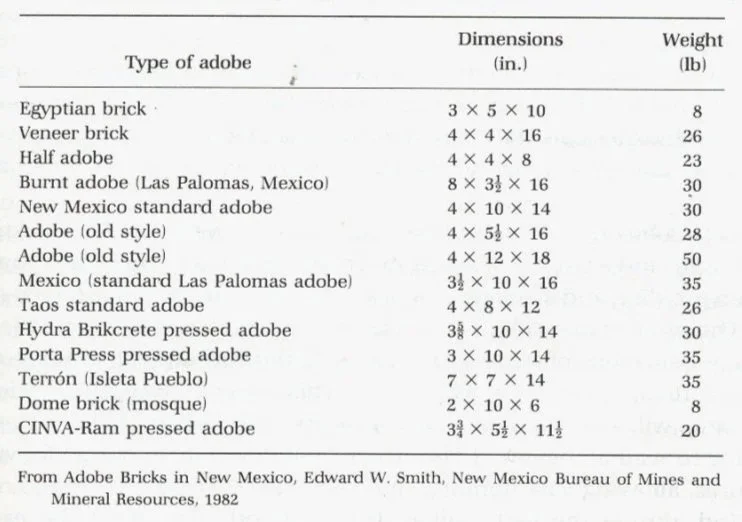
FIGURE TWO – Common sizes and weights of adobe bricks[10]
Mixing earth, clay, water and straw is a back breaking task and sometimes mechanical or animal means are used to speed the process. It should be mixed on a non-porous base such as a slab of concrete or wooden board, sometimes it is mixed in a pit or by mechanical mixer (such as a mini-digger with crawler tracks[11]), though this is not common. When the earth is ready to be used it will have the consistency of bread dough and will not be too sticky.[12] A good skill to master is knowing when the earth mixture is mature, in other words when it is ready to use. Some people prefer to leave the mixture over night (12 to 24 hours) to allow it to mature; it should be covered with plastic sheeting if this is to be done. A good mixture of cobb will consist of 15% to 30% clay; 10% to 30% silt; and 40% to 75% sand.[13] If the mixture sticks to your boots too much then it will be impossible to put into the brick mould, this means there is too much clay present so more earth and straw should be added to make the mix drier. If the mixture cannot be made drier it is possible that the soil is too clay rich and extra aggregate should be added.[14] See Figure Three for examples of brick moulds.
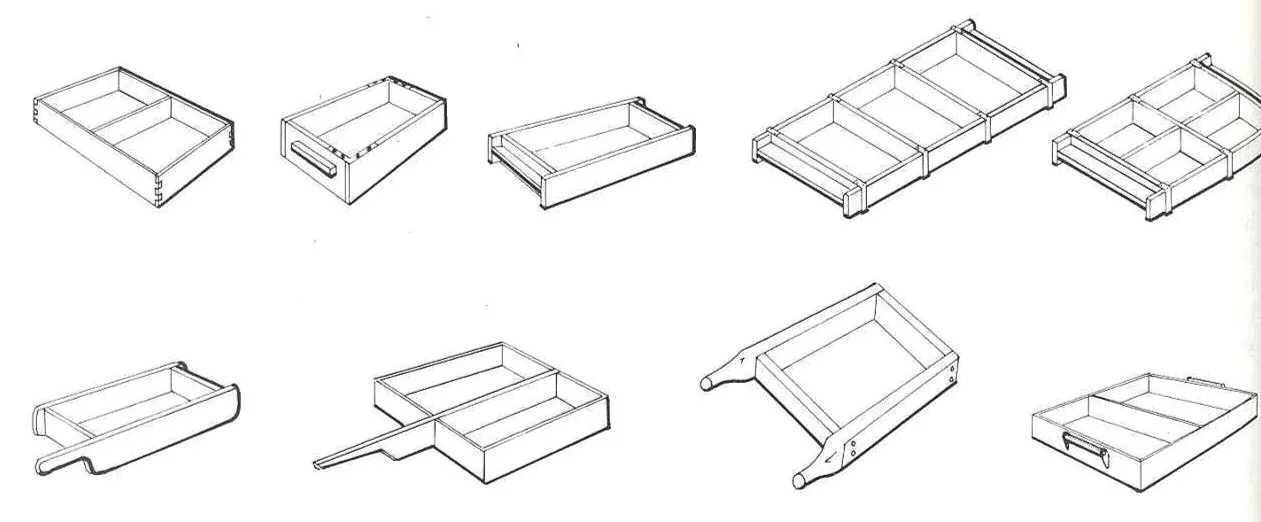
FIGURE THREE – Examples of adobe moulds[15]
Using adobe bricks is just the same as constructing with normal bricks except that the mortar used is simply made of mud. All of the normal techniques are used, a string to keep the courses level, a mortar to bond the bricks, etc. Though cement mortar can be used it is not common, and I personally would not recommend it. Not only is it not sustainable, but mistakes cannot easily be remedied. As with any brick building, the erection of an earth brick building is rapid and simple. The “stretcher” bond is normally employed, with a 20mm thick mud mortar. Interior and exterior cobb walls can be rendered and/or plastered. [16]
All types of earthen construction require regular maintenance and adobe is no exception to this rule. Some may think of this as a chore, but others see it as a kind of ritual that the owner carries our his/herself. As it is a relatively unskilled job anyone can do it, male or female, young or old, even children can help![17]
Adobe is very good when used for the conservation of old buildings. Various block sizes can be produced to fill gaps that need repairing. They can be made to a specific size and are good at filling holes because shrinkage occurs in the brick while it dries, not in the walls.[18]
Rammed earth or compressed earth blocks (CEB’s)[19] are also a very good building material, but in my opinion the British work force is more suited to simple mud bricks. This is because compressed earth blocks are more laborious to produce than cobb bricks. Also they use a more skilled manufacturing process that is not as easily available as adobe blocks. For example the moisture content of rammed earth must be accurate to one or two percent, adobe can be accurate to 10 or 20 percent. It takes a long time to make a CEB because each one must be individually compressed. An adobe block can easily be made on site, from the immediately available materials, whereas a rammed earth block may need transportation or machinery to make a large enough quantity, this could make CEB’s less sustainable. Also because the soil is compressed a lot less bricks will be made than adobe bricks - with the same amount of soil.[20]
There is one element that rammed earth blocks are better than adobe, and that is that they can construct a far stronger wall to a greater height with a narrower width than an adobe wall. This is because compressed earth has a higher structural capability than adobe. For example CEB’s can construct a slimmer taller wall than adobe.[21]
While some types of earth construction become messy and almost impossible in adverse conditions building with cobb bricks does not. Obviously building in the rain is not ideal, and will make the construction process of any building work more difficult, but using adobe would not be any more difficult than any other building processes. This is because the bricks are already made and dried, there is no messy work being conducted on site when working with the bricks. Of course, it will be essential to protect them from the wet as much as possible, but working with them should still be possible. Mixing the cobb to make the bricks in the wet would not be practical, the mixture would become far too wet, and generally would not be easy to mix. Other earth building processes that may not be practicable in the wet are:
Rammed earth – where moisture content is crucial to the compressed earth mix, and too much or too little would ruin the wall;
Cobb walls – where treading the earth onto the wall would become impossible, and also so would mixing the earth and straw;
Compressed earth blocks – making these in the wet is not a good idea because moisture content would ruin the brick, though using them in the wet would be possible, as is it with adobe bricks.
To summarize adobe is the most suitable earth building technique for the British contemporary construction industry because:
Adobe blocks can be made by an unskilled labour force;
British brick-layers are familiar with handling and using bricks;
Construction with adobe is simple;
It is suitable for our wet climate (e.g. moisture content in the mixture of the brick is not an issue);
It can be easily repaired;
It has been used for thousands of years;
It is quick to build with, for example no shuttering is needed;
Once the cobb blocks are made they can be transported & stored;
Shrinkage occurs before the earth is used in the building – preventing cracking.
Bibliography:
‘AECT Compressed Earth Block Machines’ [Online] http://pages.sbcglobal.net/fwehman/ [5th December 2005]
Harrison, R (1999 Volume 3) Earth – the conservation & repair of Bowhill, Exeter: working with cobb. London; James and James;
McHenry (1984) Adobe and rammed earth buildings. USA, A Wiley-Interscience Publication;
Norton, J (1997 2nd Edition) Building with Earth. London; Intermediate technology publications;
Pearson, G (1992) Conservation of clay & chalk buildings. London, Donhead Publishing;
Romeo, O & Larkin, D (1994) Adobe. New York; Houghton Mifflin;
Walker, B McGregor, C & Little, R (1996) Earth Structures & Construction in Scotland. Edinburgh; Authors & Historic Scotland;
‘Weight Converted’ [Online] http://www.exrx.net/Calculators/WeightConverter.html [5th December 2005]
[1] Romeo, O & Larkin, D (1994) Adobe. New York; Houghton Mifflin;
[2] Pearson, G (1992) Conservation of clay & chalk buildings. London, Donhead Publishing;
[3] Romeo, O & Larkin, D (1994) Adobe. New York; Houghton Mifflin;
[4] Norton, J (1997 2nd Edition) Building with Earth. London; Intermediate technology publications;
[5] Pearson, G (1992) Conservation of clay & chalk buildings. London, Donhead Publishing;
[6] Romeo, O & Larkin, D (1994) Adobe. New York; Houghton Mifflin;
[7] Romeo, O & Larkin, D (1994) Adobe. New York; Houghton Mifflin;
[8] ‘Weight Converted’ [Online] http://www.exrx.net/Calculators/WeightConverter.html [5th December 2005]
[9] Pearson, G (1992) Conservation of clay & chalk buildings. London, Donhead Publishing;
[10] McHenry (1984) Adobe and rammed earth buildings. USA, A Wiley-Interscience Publication;
[11] Harrison, R (1999 Volume 3) Earth – the conservation & repair of Bowhill, Exeter: working with cobb. London; James and James;
[12] Pearson, G (1992) Conservation of clay & chalk buildings. London, Donhead Publishing;
[13] Norton, J (1997 2nd Edition) Building with Earth. London; Intermediate technology publications;
[14] Harrison, R (1999 Volume 3) Earth – the conservation & repair of Bowhill, Exeter: working with cobb. London; James and James;
[15] McHenry (1984) Adobe and rammed earth buildings. USA, A Wiley-Interscience Publication;
[16] Pearson, G (1992) Conservation of clay & chalk buildings. London, Donhead Publishing;
[17] Romeo, O & Larkin, D (1994) Adobe. New York; Houghton Mifflin;
[18] Walker, B McGregor, C & Little, R (1996) Earth Structures & Construction in Scotland. Edinburgh; Authors & Historic Scotland;
[19] ‘AECT Compressed Earth Block Machines’ [Online] http://pages.sbcglobal.net/fwehman/ [5th December 2005]
[20] Norton, J (1997 2nd Edition) Building with Earth. London; Intermediate technology publications;
[21] Norton, J (1997 2nd Edition) Building with Earth. London; Intermediate technology publications;
